A 1975 Scottish oil rig, a cancelled Christmas bonus, a strike brewing and an electrician fleeing an assault charge: the setup is entirely human-scale, class-and-family drama before the drill ever touches anything. The prologue spends its first stretch on workplace comedy and union politics, crew banter flowing freely, and that earned downtime is the heart of the experience. When catastrophe comes, the horror never fully erases the people. Mutated crew members still recognise faces and still speak, their personalities intact inside the grotesque, which unsettles far more than any mere body horror could. It is a horror game built on people, and it knows it.
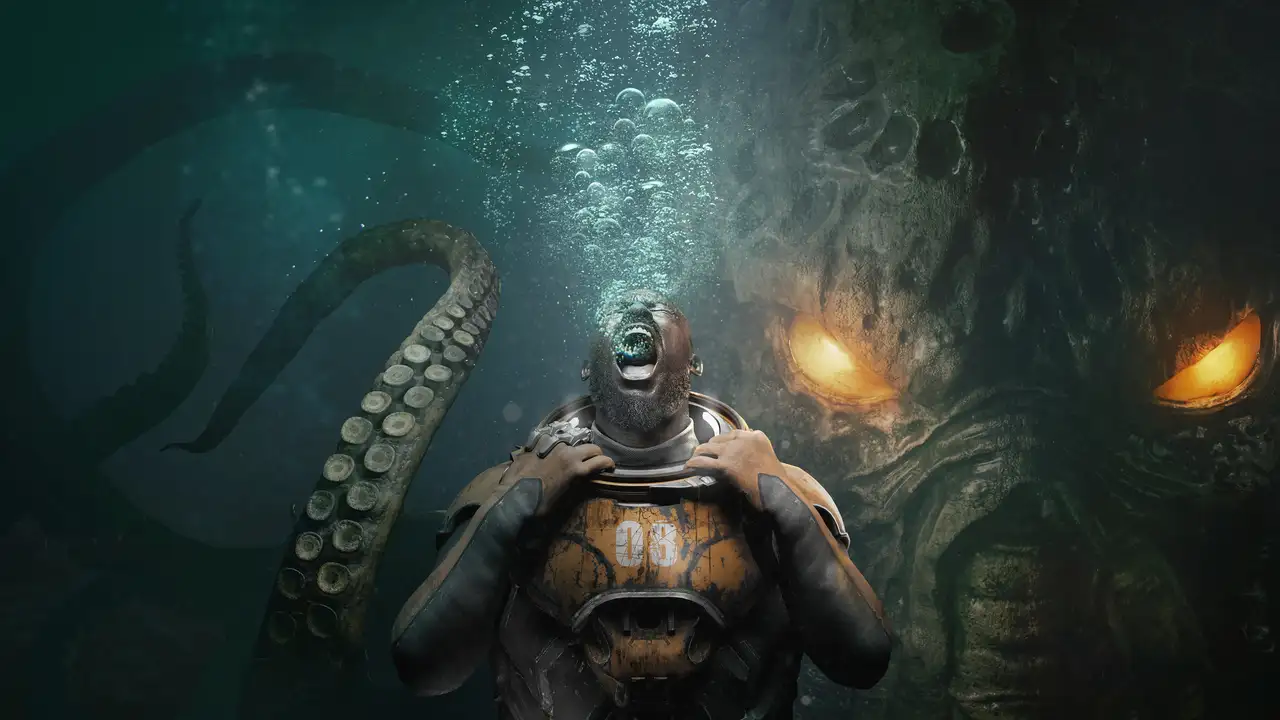
The presentation carries the catastrophe with real skill. Both the monster designs and the collapsed, sinking rig itself are visually striking, corridors torn open into a flooded iron corpse that keeps tilting further as the hours pass. The all-Scottish cast is a distinctive pleasure, thick dialect delivered with obvious affection, and the choice of plain-English subtitles over the untranslatable idiom is a charming touch. The period setting grounds everything: no mobile phones, no modern safety culture, just men in a tin can on the North Sea in December.
Traversal and environmental puzzles fill the connective tissue. Flare stacks are relit, generators restarted, tension winches cranked and marine-control ballast switches thrown, while climbing and balance-beam sections use a hold-to-grip system. The straddling animation deserves specific praise, dropping the character low across beams in a way few games bother with, and it reads as far more realistic than the usual upright shuffle. Checkpoints are short and deaths rarely punish, keeping momentum through the chase-and-hide stretches.
The stealth-horror design is functional but readable to a fault. Vents, lockers and throwable objects telegraph every encounter long before it begins, a dead giveaway of exactly when hiding will be required, and one mid-game section breaks the stealth pattern entirely, catching anyone who assumed the established rules would hold. Monsters cannot enter hiding spots, which removes genuine threat from the concealment loop. Competent throughout, the stealth never rises above predictable, and it is the design’s clearest structural limitation.
Technical jank surfaces at awkward moments. A camera locks onto a wall during one monster encounter, a flashlight glitches inside vents, and deaths occasionally come from running into geometry rather than any creature. A recurring rendering bug, pink squares on menu transitions, plagues one platform and yields only to the open-and-close-the-menu workaround. None of it breaks the campaign, but the accumulation grates, and the slow unskippable credits minigame that closes both the base game and the epilogue tests patience precisely when goodwill should be cashing in.
The companion epilogue pivots the whole structure from hiding horror to solemn underwater wreck investigation, a mostly-calm two-hour coda whose reflective register suits what precedes it. Its floaty swimming controls are the weakest element, imprecise underwater in a way the terrestrial movement never is, and a late chase section repeats the base game’s worst habit inside the DLC’s calmer frame. As an elegy, though, it lands, recovering something personal from the ruin and letting the story close on its own terms. The entity itself is never explained, and the withholding reads as deliberate rather than coy.
Overall, this is a confident, human-scaled horror game whose crew banter, all-Scottish cast and monsters who remain people give it a warmth few entries in the genre attempt, wrapped in striking visuals and a finale that refuses consolation. The telegraphed stealth, floaty epilogue swimming and assorted camera jank are real, but none dent the conviction. Few horror games earn their tragedy this thoroughly.