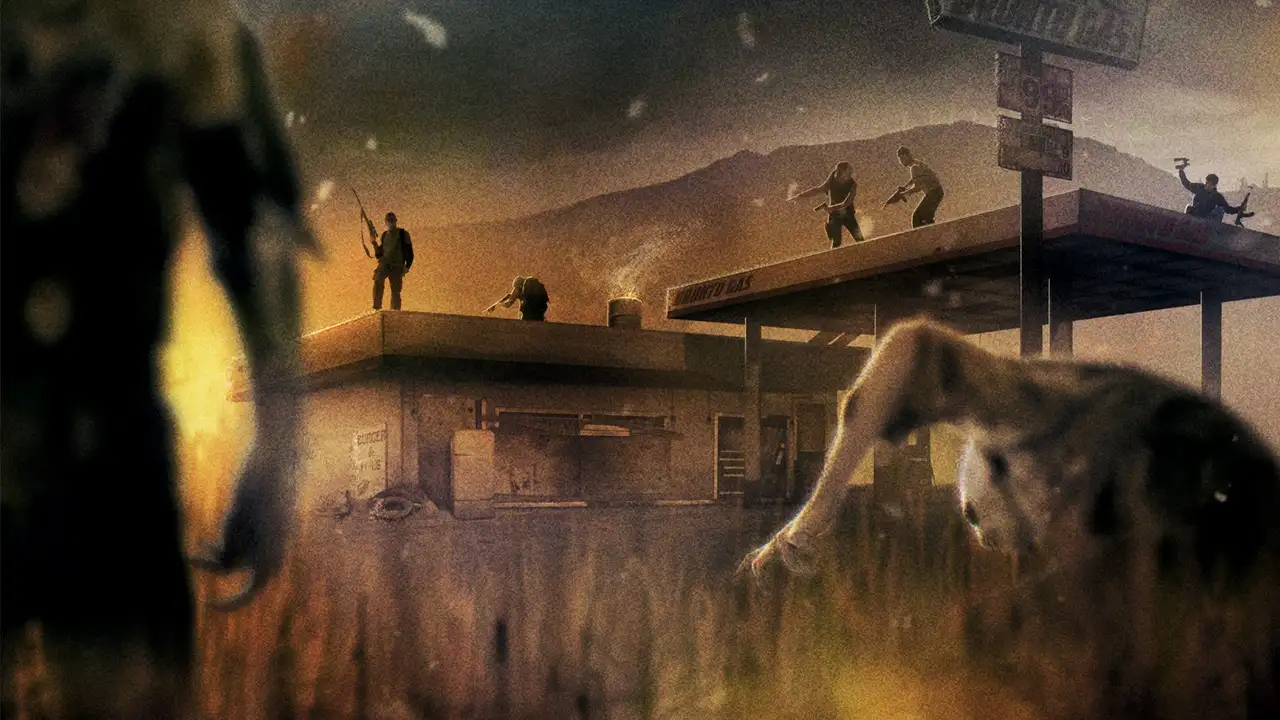
A small-town American apocalypse in Trumbull Valley opens the campaign, with a courthouse storyline, a moonshine family and an army camped across the river giving the setting genuine locality. Environment-driven storytelling does the heavy lifting: memorial notes, diary entries and radio chatter build the world far more effectively than any cutscene could. The tone is grim but peppered with dark humour, and the community’s rotating cast of tired, injured and sick survivors creates stakes that individual-hero games never manage. Off-screen simulation is the heart of the design, with enclaves collapsing, NPCs dying and missions spawning while attention is elsewhere. The valley feels genuinely alive in a way few zombie games attempt.
The skill system levels Cardio, Fighting, Shooting and Wits through use, capping at seven with specialisations that reward committed builds. Roundhouse-kick knockdown builds became the signature tool, gleefully spammed across every encounter, though the temptation to specialise every survivor identically is a trap the system allows. Every character can achieve high levels in the same fundamentals, which makes the roster feel genuinely flexible. Loot-heavy scavenging feeds the loop, hauling rucksacks by car from Infestation-cleared buildings. Permadeath gives every excursion real weight.
Base building anchors progression, and the home-site relocation to a Marshall warehouse delivers a satisfying mid-game power spike that opens the courthouse storyline. Cars are essential, with six-slot-trunk pickups forming the haulage meta, though floaty driving physics and constant crashes make every journey its own comedy. Infestation clearing keeps the map honest, and the Juggernaut, initially feared as a death sentence, demystifies into a manageable puzzle once its weaknesses register. Zombies climb barbed wire regardless, undermining base-defence logic in ways the simulation never explains. The systems interlock with an intelligence rare for 2013.
The Lifeline DLC restructures the campaign entirely, shifting to a besieged army outpost in Danforth with VIP extraction, threat-level sieges, drone strikes and a genuinely tense ending. Outfitting every survivor with grenade launchers transforms siege defence into the package’s most memorable power fantasy. A strong cast, including a special-forces hypochondriac and a radio host, carries the DLC’s personality. The structure is a genuine evolution rather than more of the same. It stands as a highlight of the whole release.
Lifeline’s constant downtime between sieges is the DLC’s defining flaw, with long stretches of waiting for the next mission that test patience severely. Repeated dialogue lines grate over an eighteen-hour campaign, trade offers are never worth taking, and indoor movement slows unexplained. The weapon-durability display is confusing and occasionally bugged, flagging full-bar weapons as damaged, and the danger-zone mechanic communicates itself inconsistently. Companions cannot be directed to carry loot. A broken melee weapon leaves a survivor nearly defenceless, the one area the sequel genuinely improved.
The Year-One Survival Edition’s additions are substantial, with a noticeably expanded weapon and gun pool that changes the early game’s scarcity calculus entirely. Memorial notes and diary entries scattered through the world reward thorough scavengers with small, human stories the main plot never touches. The Wilkerson family’s trade mission carries a genuine sting for anyone who accepts it, a story beat the structure never telegraphs. Even the ferals and hordes cycle through the simulation with a relentlessness that keeps every drive a calculation.
Overall, this is a systems-first zombie simulation whose living world, skill depth and permadeath stakes have aged far better than its presentation, with Lifeline’s grenade-launcher sieges standing as a genuine highlight of the whole package. Downtime, repetitive dialogue and 2013-era jank are real costs, but the systems underneath remain exceptional. A clearly worthwhile visit for anyone who appreciated its successor, and the tighter, story-driven original campaign holds up remarkably.