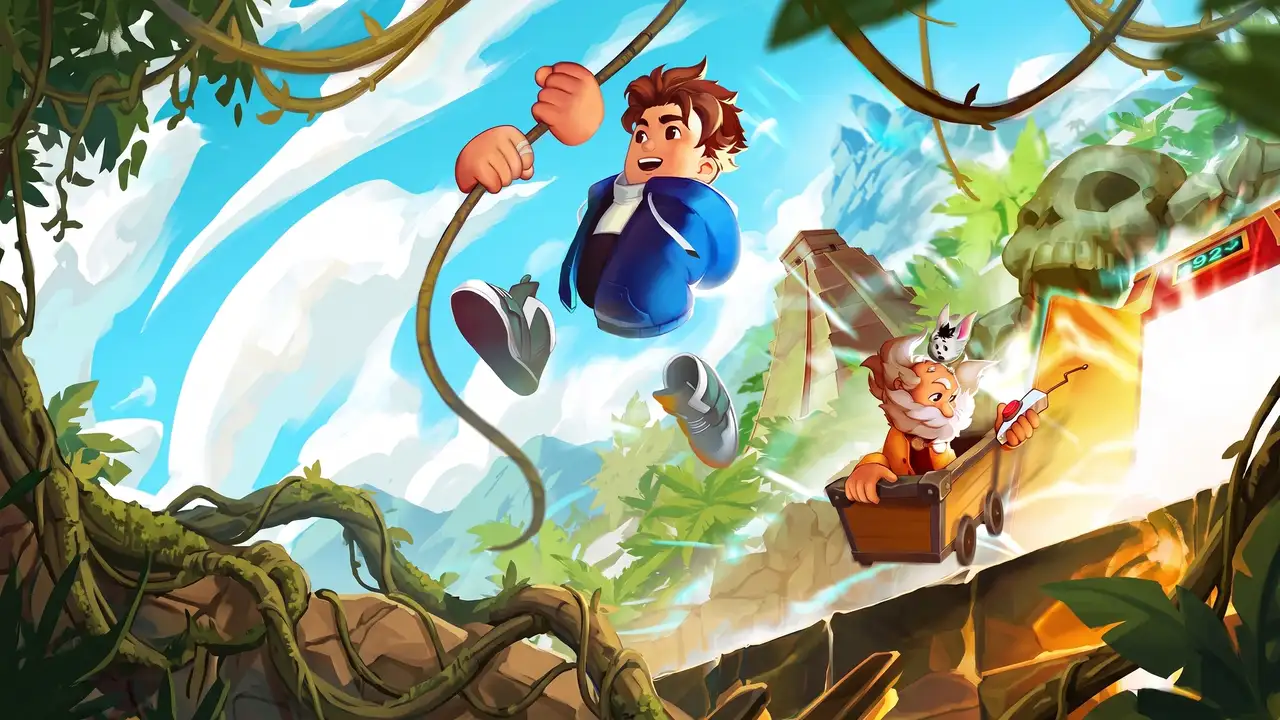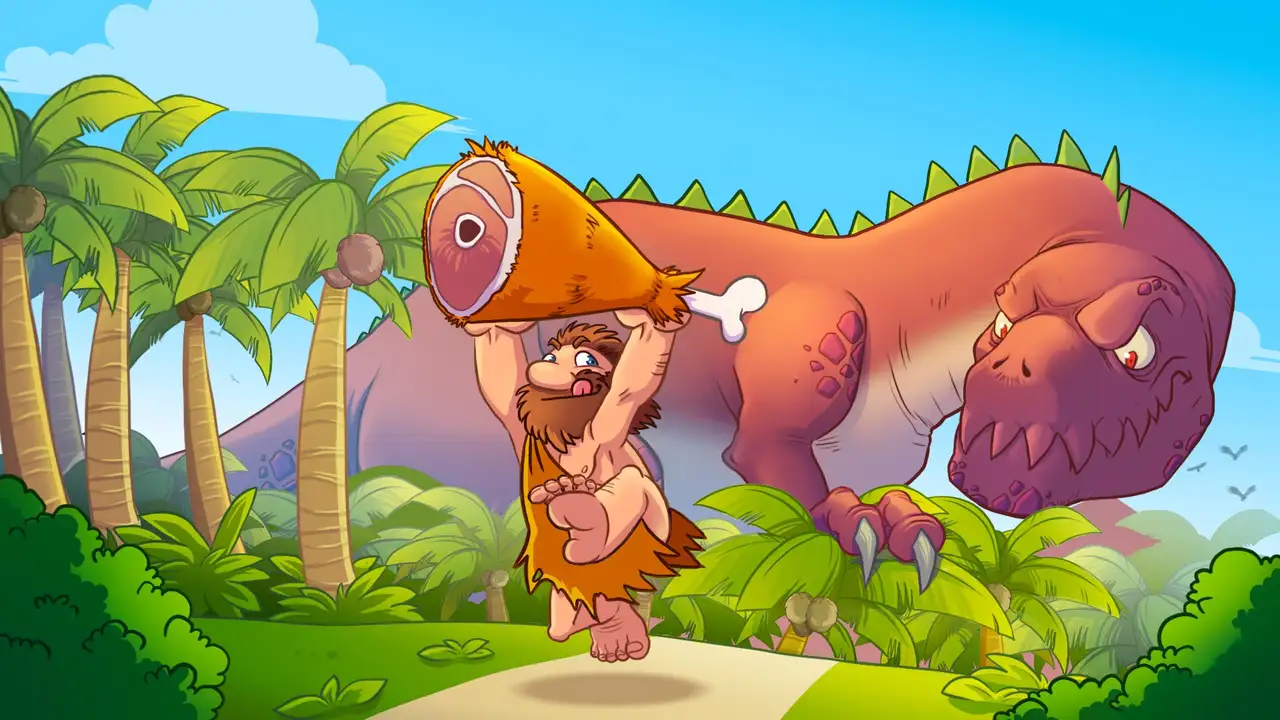
A friendly caveman’s giant ham is stolen by a dinosaur, and the chase is on. The setup is pure Tom-and-Jerry cartoon logic, played entirely for comedy: prehistoric civilisations with levers and birthday cakes, swimming animations of maximum goofiness, and animals that reward the hero with cake as a full heal. The wordless story hides a warmer heart than expected, reframing the finale around the dinosaur’s own motives in a way that turns a silly chase into a story about friendship. The charm works precisely because it never aspires to more than it is.
Ability progression is the mechanical core, and it is done properly. Ledge-grab gloves, underwater breathing, double jump, a dash, and a post-game sprint coconut all gate movement through boss encounters, exactly as the genre demands. Axes provide ranged attack, the club handles melee with a charge throw that one-shots most enemies once upgraded, and health and stamina bars fill out through upgrades and chests across the map. It is a complete Metroidvania loop compressed to coffee-break length, and the honesty of that compression is its best feature.
Level design follows a learnable rule. Every area yields exactly one major find, an upgrade, a chest, or a key, and the player can reverse-engineer the pattern midway through and navigate efficiently. Screens-based platforming keeps the map compact, and the key gates the exception that keeps the rule honest. Completion lands around 90 minutes at full map clear, with a 30-minute speedrun plausible for the inclined, and the credits sequence is unusually well crafted for a budget release.
The fruit economy is the pacing drag. Fruit doubles as gate currency, and late-game tolls demanding 100 or more pieces force tedious back-and-forth farming with no reliable harvesting source. The grind arrives exactly where momentum matters most, and no farming route makes the accumulation painless. It is the one design choice that feels at odds with the game’s own bite-sized philosophy.
Hitboxes and enemy visibility cause the recurring combat friction. Snakes in particular cannot be seen until walked into, and imprecise contact boxes punish otherwise simple platforming. Occasional soft-lock-style freezes mid-attack interrupt the flow, and the final boss confuses by implying only its head is vulnerable when any hit counts, costing unnecessary retries. None of these are serious, but they cluster in the late game.
Food as a concept puzzles more than it functions. Beyond the gate currency, food serves no healing purpose, which makes early hauls feel purposeless until the toll gates reveal themselves. The joke premise of the caveman diet lands better than the mechanic behind it, and the game would be cleaner if the two roles were separated. As is, the economy is the least thought-through system.
Combat difficulty stays low throughout, which suits the tone even if it removes stakes. Bosses gate movement rather than test skill, enemies pose a threat only through invisibility rather than design, and the challenge comes from navigation rather than reflex. For a palate-cleanser between larger games, the easy going is a feature rather than a flaw, and the map’s compact size means 100% is a realistic single-sitting goal.
Overall, this is a small, cheerful, honest mini-Metroidvania that knows exactly what it is: a complete ability-gating loop, a goofy cartoon skin, and ninety minutes of light platforming. Fruit-toll farming, invisible snakes, and attack freezes are the rough edges. It delivers precisely the bite-sized fix it promises, with charm to spare.