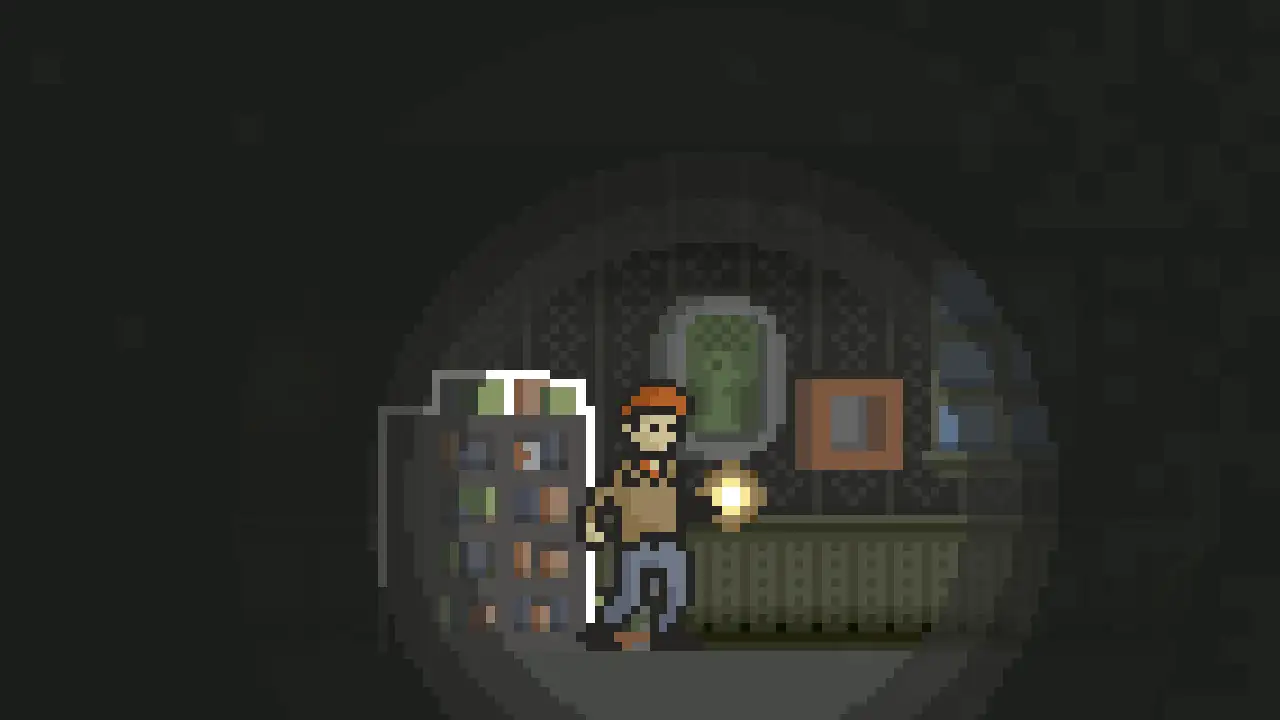
Fleshy, bloodstained mannequins stand in every corridor of a dystopia run by an authoritarian Sovereign, and the game never lets the dread ease. Fixed-camera angles evoke early Resident Evil and Silent Hill immediately, sombre music and radio messages sustain the homage, and the atmosphere holds from the opening room to the credits. As a tonal swerve from the developer’s pixel-art action roots, it is also a statement of intent: the horror here is bureaucratic, a classification system that sorts evacuees into categories with names like mannequin, stalker and involuntary.
The reveal behind the mannequins recontextualises the whole horror. The transformed citizens of a screening process gone monstrous, the fleshy figures stop being set dressing the moment their origin registers, and every earlier encounter reads differently afterwards. The final act goes further, revealing the world as a proto-space inside the protagonist’s mind with a guide steering from outside, a twist that lands as genuinely impressive rather than gimmicky. It is the kind of structural pivot the genre’s best entries trade in.
Puzzles lean on classic survival-horror vocabulary. QR-code hints, poem-encrypted keypads, colour-coded impulse converters, safes with hypersensitive dials and an eyeball that belongs in a retinal inlet all fill the loop, and the satirical QR-code propaganda doubles as an unexpected ARG layer that rewards attention. VHS cassettes seed mysteries, including a bathtub enigma that delights precisely because it goes unexplained. Inventory management lets dropped items persist in the world, so anything abandoned in a panic remains where it fell, and the mid-run shotgun arrival is the arsenal’s genuine high point, arriving exactly when the corridor-clearing pressure peaks.
The modern control scheme is the game’s trap. Built for tank controls, the game fights the camera-relative alternative with reversed movement on camera snaps, slower-than-ideal character speed, and fiddly aiming, and the friction compounds across the whole run until switching to tank controls for the final boss immediately improves everything. The mistake is a common one and the game never steers players away from it, which makes this the rare review where the most important advice is a settings tip: pick tank controls.
Late-game gauntlets stack the deck. Enemies block routes, scream to slow pursuit, and speed up when shot, and the saw-blade area hides its hazards invisibly against static camera angles that never show them. Unreadable dark rooms compound the visibility problem. The sprinting stalker chase, the screen-clearing camera-charge fight and the projector finale each bring their own pressure, and the boss variety keeps the closing stretch from repeating itself even when the fairness wobbles.
The camera snap is the one design flaw worth naming directly. Transitions between fixed angles take longer than they should, and the delay lets enemies cross the cut unseen, which turns the saw-blade area from tense into unfair. With an earlier snap, most of the late-game frustration would dissolve; the rest of the design holds up under scrutiny, and the atmosphere alone justifies the price of admission. That the gravest flaws are so narrowly fixable speaks well of the foundation beneath them, and the horror craft on display around those flaws is never in question.
Overall, this is a very good, genuinely unsettling survival horror homage whose oppressive atmosphere, mannequin reveal and classic puzzle vocabulary outweigh the modern-control trap, invisible hazards and a slow camera snap. Pick tank controls, keep the lights on, and the dread does the rest.