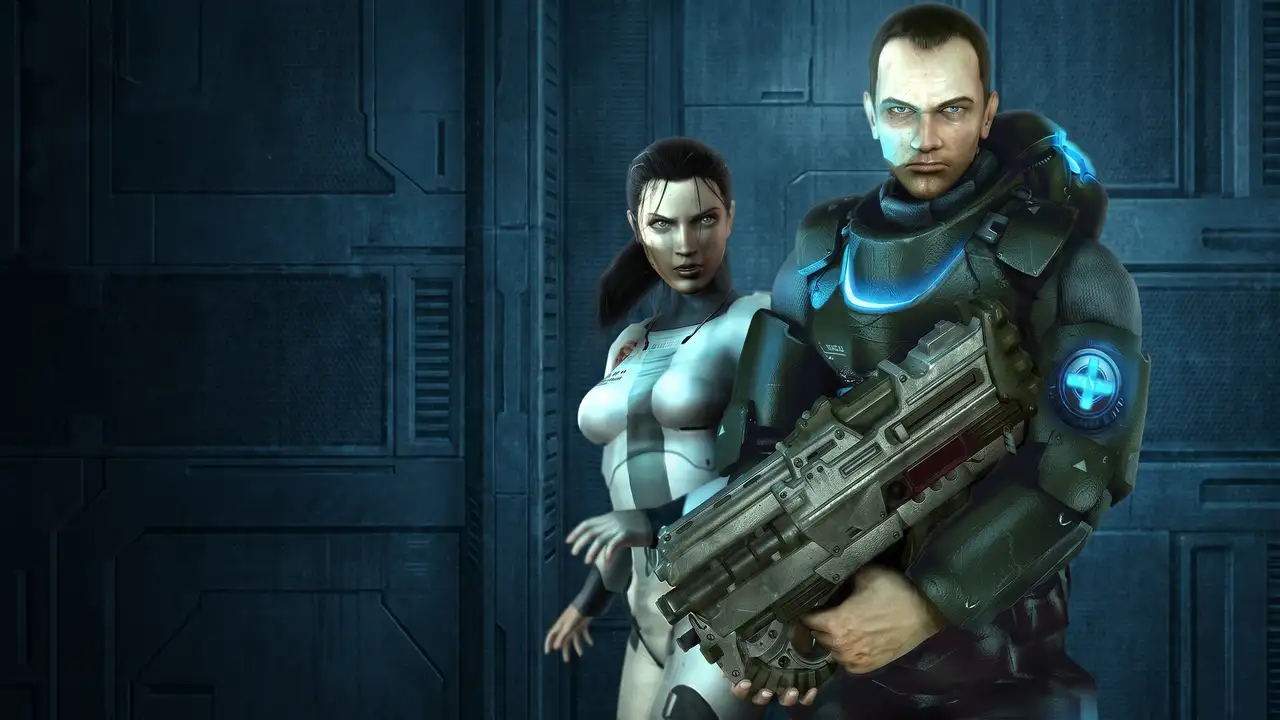
A doctor infected with a viral plague hunts a kidnapped companion across a quarantined zone, and the 2005 Unreal engine underneath renders the post-apocalypse with mid-decade solidity. The story jumps from beat to beat with little connective tissue, cutscenes snap between locations so jarringly that transitions become unintentional comedy, and the finale’s sacrifice lands without the setup to justify it. As narrative, the campaign barely hangs together; as a shooting sandbox, it holds up better than its reputation suggests.
Rag-doll physics supply the campaign’s most reliable entertainment. Bodies launch wildly from explosions, fly absurd distances under gunfire, and collapse with a comedy the game never intends but fully delivers. The delight holds from mid-game to the credits, and the physics engine’s exuberance turns routine firefights into impromptu slapstick. Few shooters of any era make enemy death this consistently watchable.
The arsenal mixes hits and misses. The Bulldog rifle earns its keep as the campaign’s best weapon, the grenade launcher disappoints with a six-round magazine that cannot reload mid-fight, and the RPG sits almost untouched because it simply underperforms. Hidden poison-gas traps ambush the early levels, killing carelessly at chokepoints before their presence registers, and the unlockable upgrade system hides so effectively that it can go entirely unnoticed until the final act, at which point the collected upgrades arrive too late to matter. Mouse sensitivity also demands immediate recalibration on PC, an adjustment the default settings actively discourage.
Enemy variety is the design’s thinnest pillar. Shrouds and soldier enemies carry nearly every encounter, drones appear in only two levels, and the absence of any third faction makes the campaign monotonous across its length. Spawn pressure compensates with volume: encounters throw relentless waves, and the finale’s never-ending stream tests endurance rather than tactics. Enemies also die invisibly at checkpoints, an odd quirk that occasionally clears rooms without explanation.
Wayfinding is the most persistent frustration. Multiple long stretches produce genuine bewilderment about where to go, with no signposting to indicate the missed route, and the confusion inflates the runtime well beyond its natural length. The train level and the drop-ship defence both exemplify the problem, and the latter compounds it by removing checkpoints entirely, costing full retries for a gauntlet whose difficulty spikes without warning.
The drop-ship level deserves its own mention as the campaign’s low point. Repeated full restarts, unclear death causes, and a defence setup that punishes positioning before teaching it make the sequence the run’s most frustrating stretch. The finale then swings the opposite direction, replacing challenge with sheer volume and ending the campaign on a note of exhaustion rather than climax.
Preservation status shapes the modern experience more than the design itself. Considered abandonware on PC, the game runs surprisingly cleanly through Linux compatibility layers, with sharpening injection making a visibly dramatic difference and no glaring issues across a full playthrough. As a relic, that compatibility is its most notable contemporary feature: more remarkable for how it plays today than for what it was.
Overall, this is a serviceable slice of 2005 abandonware whose rag-doll comedy, Bulldog rifle and Linux-friendly preservation outweigh incoherent storytelling, thin enemy variety and punishing wayfinding. The campaign is brief and flawed, but it runs cleanly on modern systems and delivers enough sandbox pleasure to justify a nostalgic visit; just bring patience for the drop-ship and a map in mind.