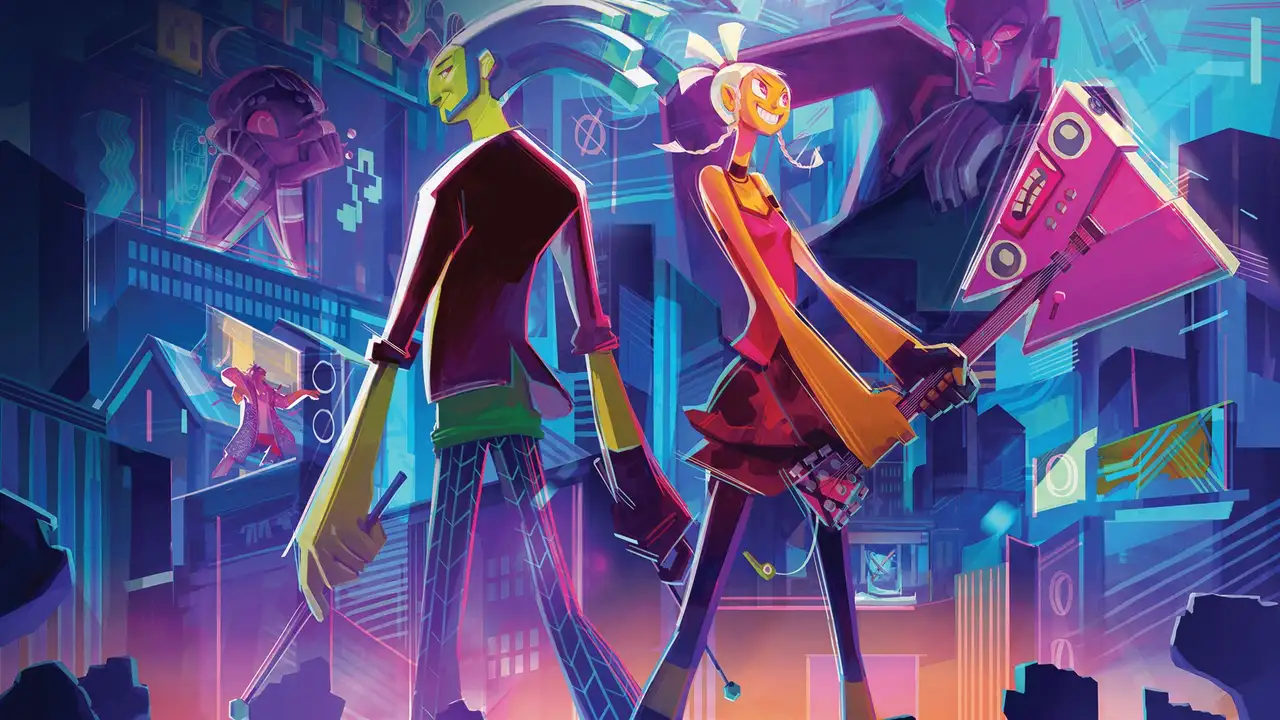
Vinyl City runs on EDM under a dictatorial label, and No Straight Roads follows a rejected indie rock duo fighting district by district to bring rock back. The music-industry satire (boy bands, idol singers, arrogant DJs, pretentious visual artists) gives the rebellion genuine satirical teeth, and the toxic-fandom thread lands as a strong thematic beat. Tone stays relentlessly goofy and bright, and the epilogue’s message of musical balance and artistic equality carries real warmth. The writing, characters and sheer charm carry a game whose combat is openly thin. A rejected duo versus an empire of electronic perfection is a premise the game honours in every system.
The soundtrack wins over from before the game even starts and stays the highlight throughout. Tracks lodge in the head permanently, from the rap-battle songs to the idol encounter’s theme, and one digital songstress’s track stands as the game’s best. Bosses literally transform the music when damaged, degrading the track as their program pieces are destroyed, a genuinely novel fusion of audio and state. The soundtrack morphs between rock and EDM mid-fight, mirroring the rebellion’s stakes in real time. Few soundtracks commit this completely to being the game rather than accompanying it.
The boss-rush structure delivers a genuine rollercoaster. The environmental digital-diva fight, the multi-phase boy-band battle with heavy platforming aboard a flying limousine, and a perception-warping gallery duel rank among the highlights, while the escalating rap battles test patience badly, with inverted dual-stick controls never becoming comfortable across three duels. One fight against a piano prodigy nearly kills repeatedly, a genuine difficulty spike. The concert-hall hijack gauntlets punctuate the boss pacing well. When the fights work, they are spectacular; when the controls fight back, they sour.
Combat is a light action system with two switchable characters, a ranged parry-heavy guitar versus melee drums, rhythmic dodge and parry windows, and special moves. Depth is thin, with attacks mostly mashable and rhythm mattering more for telegraph-reading than beat-matching, but the shallow combat is a fair trade for the personality around it. One character is preferred almost exclusively, since her ranged toolkit handles the brawls better. Upgrades fund through power cells into fans, unlocking stickers, mods and skills at a hub. The system works without ever demanding mastery.
Collectible fatigue sets in hard. The sheer volume of graffiti, power cells, stickers, mods, vending machines and unlockable transformables overwhelms and pads, and the level-three upgrades demanding repeated boss fights are not worth the grind. The city streets are crammed with pickups to the point of noise. Fast travel is absent for most of the game, with the helicopter override only discovered in the final stretch, a courtesy that should have arrived hours earlier. The hub-based economy buries its best rewards under volume.
The climax’s technical breakage is the campaign’s real scar, with a stuck portrait, desynced subtitles and overlapping voice acting marring the tyrant’s encounter, the game’s fault rather than any setup issue. The Tatiana twist itself (the tyrant being the lost rock legend) genuinely surprises despite mid-game speculation pointing there. Roughly six hours covers a full story arc, with post-game replay and remix modes available but untempting after the credits. The finale lands its themes and its spectacle even through the jank.
Overall, No Straight Roads is a charming, music-driven romp whose spectacular soundtrack, sharp satire and memorable cast more than redeem shallow combat, awkward rap-battle controls and a technically broken final encounter. The game trades mechanical depth for personality and wins the trade comfortably. A quirky, colourful, creative rebellion that deserves its encore.