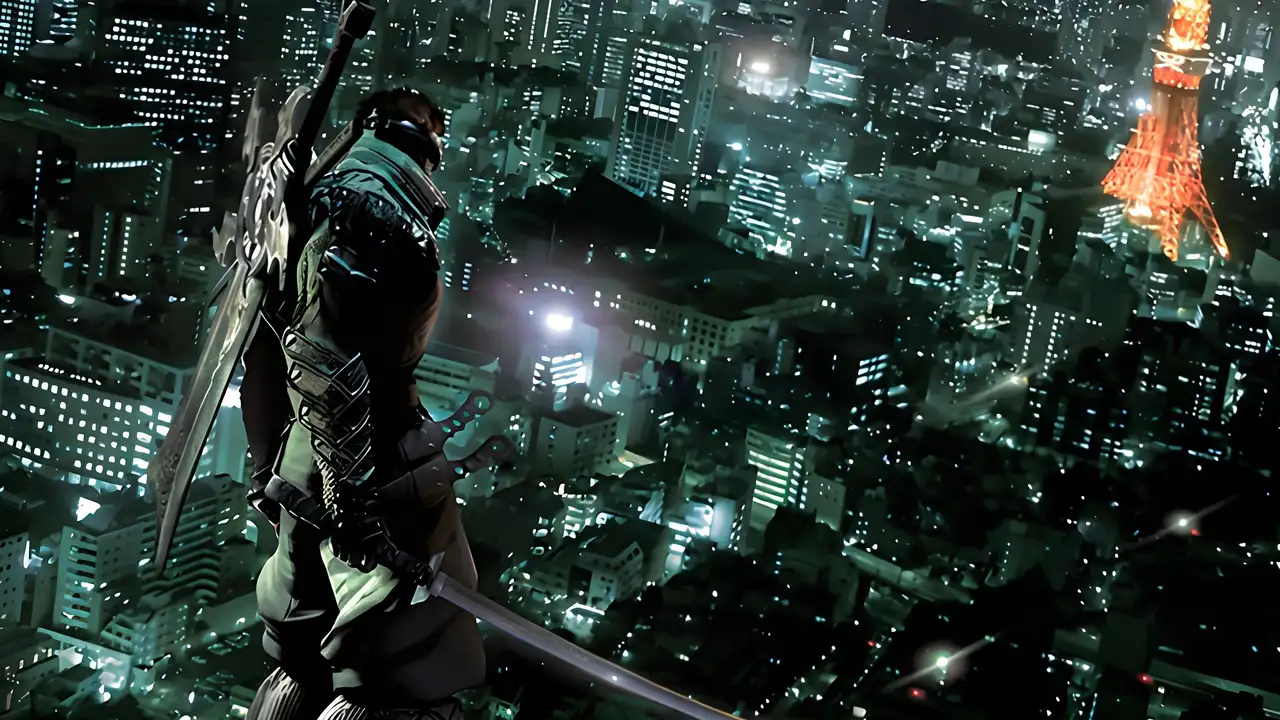
Parasites outbreak across Tokyo, citizens mutate into monsters, and a special-forces squad responds with katana, wall-run and wrecking ball. The tone announces itself within minutes and never wavers: B-movie sincerity played completely straight, cutscenes pitching melodrama over the top and then over the top again. Early-2010s character-action energy saturates everything, and the game is entirely aware of what it is.
Absurdity escalates without apology. Combat on top of a jumbo jet, a boss destroyed with a wrecking ball, a bomb-bug catapulted out of a subway tunnel, set-piece escapes strung between them; every mission tops the last by refusing to take itself seriously. The unpredictability is the point. What comes next genuinely cannot be guessed, and the game’s commitment to its own ridiculousness produces a consistency of entertainment that more self-aware titles never manage.
The forgiving QTE system makes the constant quick-time events work. Failure rewinds rather than kills, so the relentless prompt-chasing never becomes punishing, and the set-pieces stay pure spectacle. Katana combat mixes with wall-running, grapple wires, on-rails turret segments and driving sequences, and the range keeps momentum high across missions that run thirty to forty-five minutes each. Blood crystals fund weapon upgrades at mission intervals, an old-school gating structure that suits the era, with health-piece collectibles and hidden rooms rewarding exploration.
Stone Render earns its keep as the standout weapon. The great sword’s sheer damage output trumps the flashier dual katanas, whose spectacle never matches their numbers, and the upgrade economy encourages committing to a favourite. Customisation adds outfits, emblems and colour schemes, a range that most modern action games have dropped, though most unlocked outfits lean gaudy rather than cool.
The final mission re-uses earlier levels, retracing the subway and refighting prior bosses, a structure that reads as blatant even as it lands as fan service. The multi-phase finale itself delivers, capping the escalating absurdity with a fight whose boss AI can be cheerfully exploited, a flaw that suits the tone rather than undermining it. Escalation is the game’s whole grammar, and the ending obeys it.
Poorly telegraphed fights break the momentum more than the reuse does. An enemy that cannot be hit at all, a crab boss that damages on contact with every movement, and a stolen-ninjutsu sequence with unclear rules produce stretches of genuine confusion. Keyboard-only on-screen prompts throw off controller play, repeatedly triggering wrong-button mistakes in a game otherwise built for a pad. None of these design stumbles are fatal, and each passes quickly in a campaign that refuses to linger anywhere long enough for friction to set in, but they are the only moments where the momentum genuinely dips.
The PC port is the real liability. Audio layers silently drop for entire stretches, on cutscenes, turrets and even the title screen, and the collapse persists from early missions to the finale. Stuttering cutscenes compound the damage, and documented port problems confirm the fault sits with the conversion rather than the design. A good game trapped in a bad port is the accurate summary, and the Xbox 360 version remains the intended way to play it.
Overall, this is a deliriously entertaining spectacle romp whose absurdity earns consistent delight, and whose flaws live almost entirely in the port rather than the design. The escalating set-pieces, the forgiving quick-time structure and the B-movie commitment hold up remarkably well, and the audio problems read as conversion damage on a game that deserves a better host.