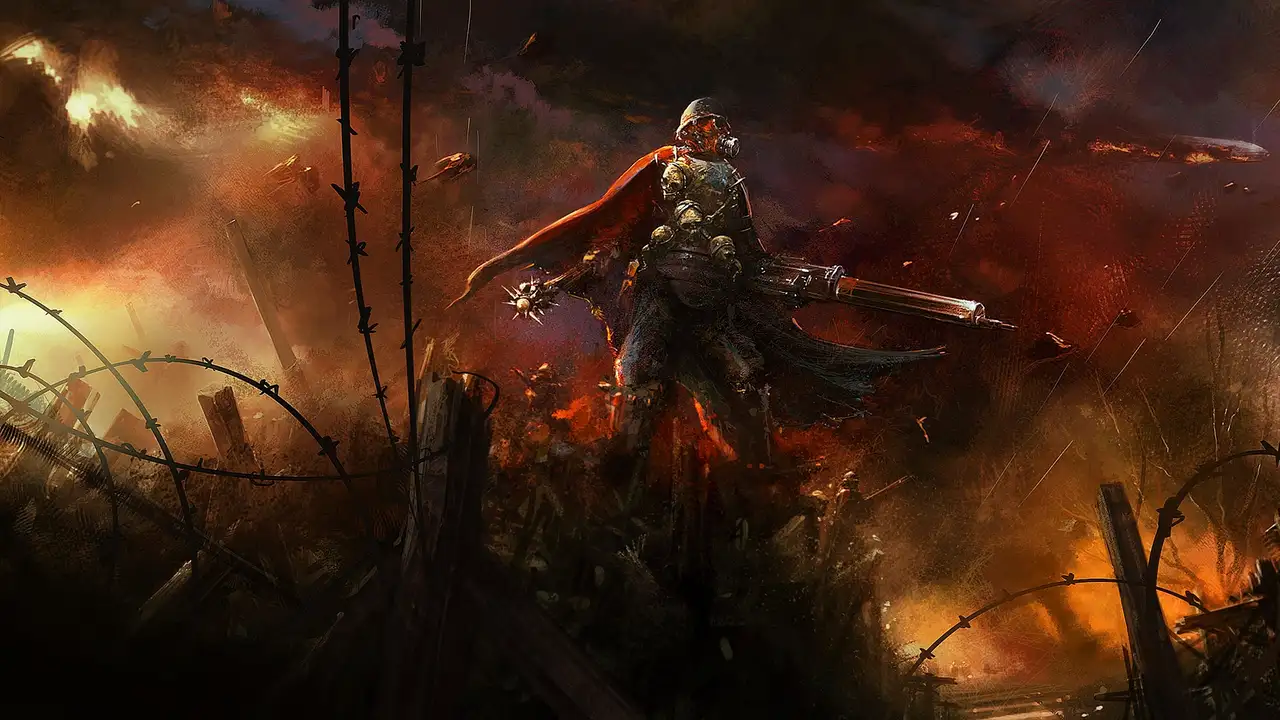
A plague cure must reach the front, and the trenches between here and there are packed with zombies, mutants and worse. This WWI horror prequel casts its player as the future villain’s origin, marching through monasteries, a hell-touched underground and eventually the gates of hell itself. The tone is B-movie pulp played at full volume: dragons over France, vampires in no-man’s-land, and a Darkwatch-adjacent swagger that knows exactly what it is.
The signature is volume. Every level’s kill count tops two hundred, and the game treats that bodycount as its identity rather than a byproduct. The trench gun turns out excellent against the undead, practically an instant kill in the right hands, and the fury/possession system adds a supernatural layer whose max-tier upgrades gate behind collectible vampire artifacts. Run-and-gun combat is the whole grammar, and the arsenal (pistols, rifles, grenades, gas masks) supports it without frills.
The power spike arrives late and lands hard. The Wolverine claw, treated as a reward for surviving the ammo-starved stretch before it, transforms the combat into a gauntlet of gleeful overkill, and the vampire arsenal compounds the fantasy. Its predecessor unlocked the equivalent roughly halfway through its campaign, and the delay here makes the pre-spike hours feel like a toll rather than a build. The tank-driving mission earns its destruction without qualification, and the plane mission shows flashes of the same energy despite missing basic controls like a slow-down button.
Enemy behaviour is the campaign’s heaviest anchor. Zombies and their kin absorb dozens of rounds, taking shots for days while spawn surges replenish them with no rhyme or reason, and the pre-finale stretch starves ammunition at precisely the wrong moment. Shield enemies demand frontal patience the arsenal does not always reward, and assassin-type enemies tank the frame rate as a bonus insult. The volume is the point, but the sponginess makes volume feel like arithmetic rather than action.
The finale stumbles twice. A golem fight with unclear mechanics and constant adds chases the player in circles while health whittles from every direction, and the dragon above WWI France drops fireballs that the frame rate renders nearly invisible. Possessed-enemy allies, the possession system’s payoff, broke their AI outright twice during the closing fights, standing slack while the horde continued. What should be the campaign’s crescendo plays as endurance testing.
Collectible letters carry the worldbuilding with unexpected charm. Doctor’s notes, soldier letters and a cobalt explorer’s journal flesh out the plague, the trenches and the occult subplot, and the writing commits to its pulpy register without winking. A Patton guest-spot supplies the campaign’s biggest grin, and the story’s central betrayal of a commanding officer lands with genuine weight despite the B-movie wrapping. The prequel framing, playing the villain’s origin, gives the plot an arc the shooting alone would lack.
Performance holds except where specific enemies intrude. Assassin-types and the dragon crater the frame rate at the exact moments clarity matters most, and the coincidence of that dips with the hardest fights compounds the difficulty unfairly. The single-session campaign runs long enough to exhaust its ideas by the final act, and the repetition of trench-to-trench traversal wears before the power spike rescues it.
Overall, this is a ridiculous, fun-but-janky B-movie shooter whose pulpy energy, late power fantasy and corny-but-committed storytelling carry it past spongy enemies, spawn floods and broken boss AI. The kill counts are absurd, the dragons are loud, and the Wolverine claw eventually makes it all worthwhile; the price is patience through the spongier hours.