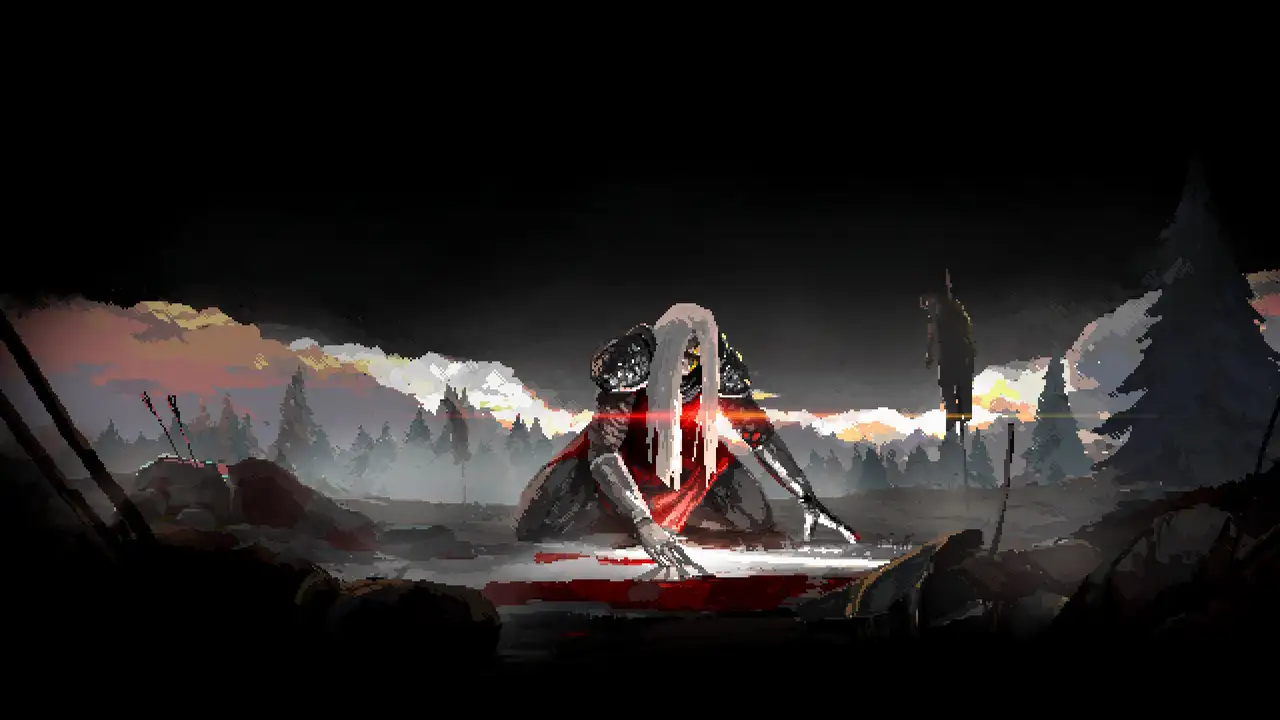
A grim moon-worshipping dark fantasy unfolds across interconnected clay kingdoms, where clay-born creations serve a failed god and the Sculptor’s abandoned masterpieces litter the world. The clay-body horror aesthetic is genuinely distinctive: crumbling vessels, bone-white moonlight and a palette that makes every kingdom feel excavated rather than built. Atmosphere carries the game even when its prose falters, and the mood-heavy storytelling rewards note-reading more than clean comprehension.
Death is the design’s centrepiece. The spike/bonus system grows passive buffs with levels and loses them (partially recoverable) on death, turning every corpse into a decision, while the doppelganger mechanic spawns a shadow of the player to hunt down and reclaim banked bonuses. Losing progress to a stronger version of yourself is a novel soulslike touch, and the encounters it produces feel like duels with your own past. Death here is narrative event rather than checkpoint reset.
Parry-driven combat rewards timing with a punishing read: the red-eye telegraph demands a response within roughly a second, and leaning on parries exclusively becomes a trap. The first boss punishes that habit brutally, and the adjustment to offence over defence marks the real skill curve. Wall-jump arrives from the start rather than as an unlock, an unusual choice that reshapes exploration expectations, and special weapons (harpoon, pinwheel, whirlwind, wormhole) each carry build-up costs with distinct statuses.
Witchery spells and glands fund a secondary magic layer, bone powder serves as currency, and the map proves surprisingly detailed for the genre. Dark mirrors function as both saves and fast-travel points, gated behind tasks that thread optional content through the kingdoms. Side quests (a sister’s whereabouts, an old queen’s eyes, a set of earrings) give the world texture, and the Light Earring collectathon stands as the one deliberate skip for completion-averse players.
Difficulty balance wobbles throughout. Early enemies hit harder than their starting-area station justifies, late-game foes feel overtuned, and enemy design quality varies wildly between encounters worth admiring and pursuers that become objects of pure hatred. The invincible glowing chasers rank among the genre’s most irritating stalking enemies, and endgame respawns during the boss run replace meaningful foes with filler, draining the stretch of tension just when it should peak.
Hitboxes and telegraphing betray the fairness the parry system depends on. Spear thrusts connect well outside their visual lines, a discrepancy the phrase “absolute bogus” was coined for, and the unfairness stings most in a game built on precise reads. The wormhole upgrade epitomises the cost-versus-payoff problem: a witchery investment that accomplishes nothing noticeable. Hold-to-interact inputs add a modern-friction irritant to a genre that thrives on responsiveness.
The permanently missable dark mirror is the campaign’s cruellest trap. Gated behind feeding a cat milk that can be missed entirely, its fast-travel point locks out permanently without warning, a design decision that punishes exploration order rather than skill. Combined with stunted, seemingly mistranslated dialogue that leaves words missing from key scenes, the presentation layer fumbles what the mechanics layer builds, and the story’s late reveals land half-obscured by prose that cannot support them.
Overall, this is a solid, distinctive soulslike metroidvania whose spike and doppelganger death mechanics, parry-driven combat and clay-body atmosphere earn their recommendation despite inconsistent hitboxes, one cruel missable and dialogue that stumbles. The moon-worship framing sets it apart from its genre peers, and the shadow-hunt mechanic alone justifies seeing how death becomes the game’s best idea.