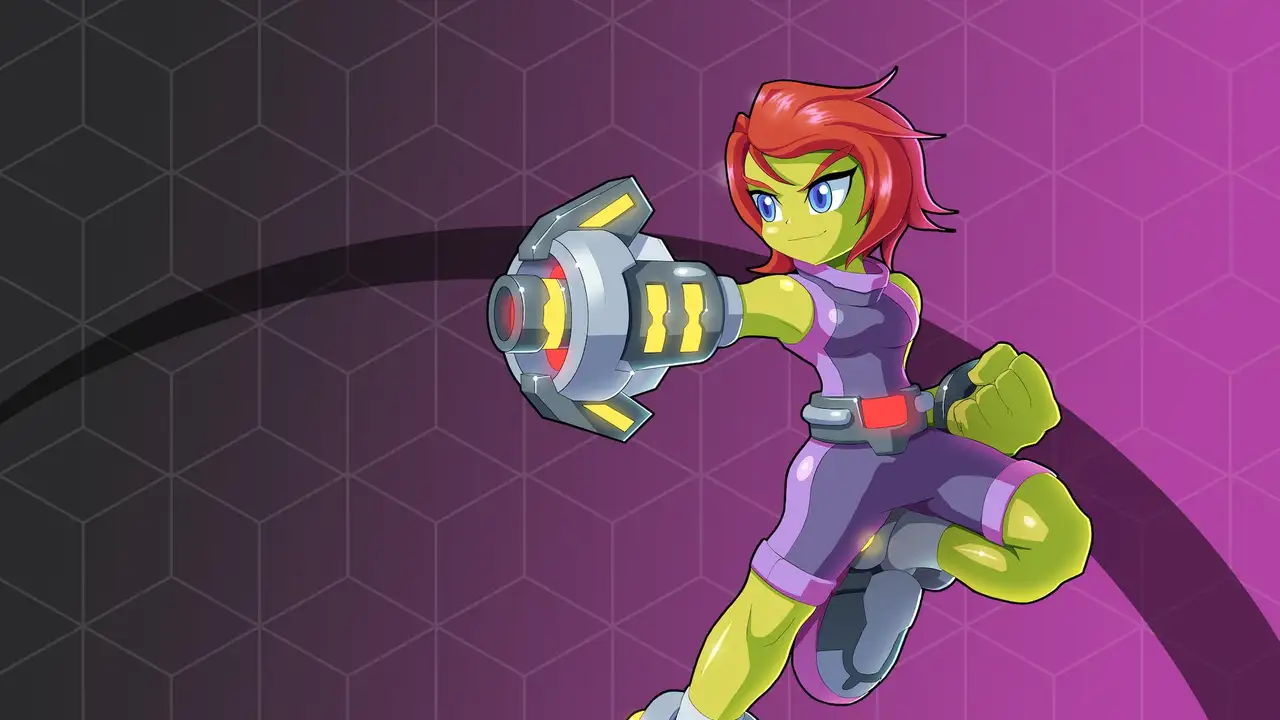
A brightly coloured lunar platformer sends the daughter of the first Moon-walker and a Selenite queen to harvest 200 crystals and cure her dying mother. The premise is amiably thin, and the game never pretends otherwise: a friendly alien helps exterminate his own species without ceremony, the crystal quota is treated as a simple chore, and the tone stays light throughout. Ten zones of six or seven short areas each provide the structure, with hazards rotating between lava, ice physics, underwater segments, and poison gas to keep the platforming varied.
The dash is the game’s masterstroke. Unlocked through gem energy, it renders the player invincible, doubles as an offensive tool, and eventually becomes the intended answer to nearly every hazard. Dashing through enemies refunds health, dashing through lava and gas bypasses them entirely, and the mechanic converts a cautious shooter-platformer into an aggressive flow-state game. Every enemy and destructible drops energy to fuel it, so the economy feeds itself and the dash never stops being fun.
Exploration design earns equal credit. Doors never lock behind the player, so backtracking is always available and full map-clearing is painless, and health and energy upgrades plus blaster improvements reward the thorough. Secret rooms telegraph themselves through alien-face carvings, a readable visual language that mostly holds up, though the signs occasionally lead nowhere and faith in them wavers. Per-zone bonus rooms are a stranger proposition, placed in clear view rather than hidden, which makes the word bonus mean something different in every zone.
The 200-crystal count is the design’s biggest opacity problem. The display caps at 99 for most of the run, its purpose goes unexplained, and the number sits in the interface inviting second-guessing until the credits finally reveal its role. A clearer explanation of the quota would have cost nothing and saved the player from an entire run of speculation about what the counter meant.
Difficulty stays undemanding throughout. Bosses fall in seconds, one underwater encounter in particular lasts barely longer than its intro, and another can be trivially parked by standing in one spot while the boss cycles into range. The low challenge suits the relaxed tone and welcoming structure, but anyone arriving for test-of-skill encounters will find none, and the final act offers nothing harder than the first.
Audio mixing is the roughest edge. Levels are mastered painfully loud even at reduced volume, with ear-splitting spikes that force conservative volume settings for the whole campaign. Hitboxes and visibility have their own rough edges: damage occasionally arrives from enemies that cannot be seen, knockback behaves oddly, and shooting upward while double-jumping is inexplicably disallowed. Two crashes interrupted the session without derailing it, and no progress was lost.
Completion runs about two and a half hours for a full clear of crystals, upgrades, secrets, and all ten zones, landing mid-range among typical completion times. The pace suits the material: zones are short, checkpoints are frequent, and the loop of shoot, harvest, dash, and explore never wears out within the runtime. The Mega Man-style bones show throughout, and the structure honours them without overextending.
Overall, this is a cheerful, sharp little run-and-gun whose invincible dash economy and never-locking doors make full exploration a pleasure, undercut by loud audio mastering, invisible damage, and an unexplained crystal counter. The low difficulty and brief runtime are honest about the game’s scale. Easy to recommend as a palate cleanser, provided the volume starts low.