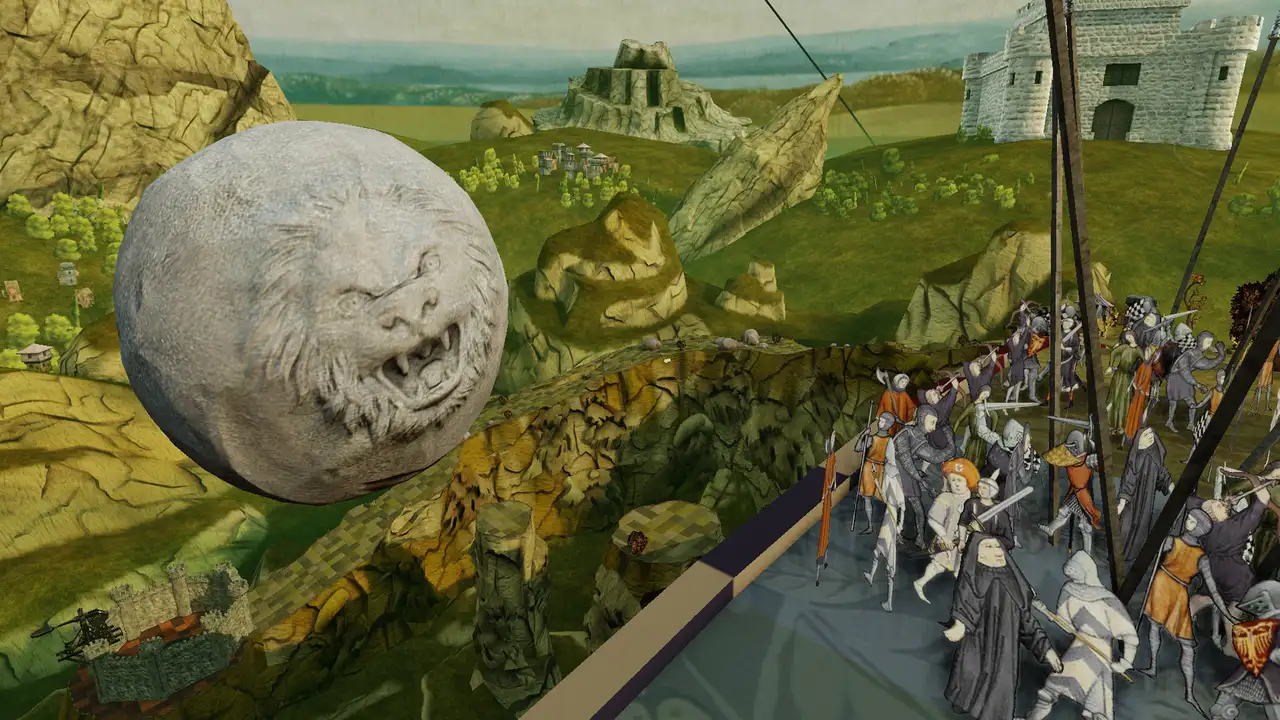
A silent princess returns sacred geometry to a valley of stripped monuments, narrated in sparse, poetic interstitial text that treats the whole campaign as a fable rather than a story. The buildings only connect when the camera says they do, and walking paths that exist from one viewpoint and vanish from another is the trick the entire design is built on. A pop-up-book box unfolds into a whole castle, walkways rotate, the totem companion carries the wanderer, and impossible geometry flips with a crank. The illusion is the game, and it lands nearly every time.
Every level feels creative and distinct, a judgement the design sustains from the opening chapters to the final expansion. Ten main chapters run roughly ninety minutes, with Forgotten Shores adding eight more, each with its own gimmick: water pressure, automation, a hat-stealing thief. The standalone dream chapter, originally created for charity, supplies the campaign’s hardest puzzle. The water palace and spire chapters build the mid-game’s momentum, and the descent’s ambient, sinister sound design gives the fable its shadow. Nothing repeats itself.
The optical illusions are the defining appeal, and they genuinely frazzle the brain even when the solutions are simple. Most answers are simpler than they look, arrived at by messing with what is on screen rather than reasoning from first principles, and the design rewards experimentation over logic. The Citadel of Deceit and the dream chapter’s final room deliver genuine head-scratchers, the only stretches where the illusion trick turns hostile. Overthinking is the player’s own worst enemy throughout.
The snap-to-target controls are the main mechanical gripe, snapping the cursor to different parts of the geometry rather than allowing free movement. A hold-to-free-aim option, with snapping on a held trigger, would have solved the entire complaint, and the fix is obvious enough that its absence stings. Movement remains legible despite this, and the illusion-craft never suffers for the input method. The complaint is real but contained.
Sound design earns its own praise, with moving platforms carrying the gentle flourishes of a certain cel-shaded seafaring adventure and ambient tracks that shift with each monument’s mood. The totem friend endears himself immediately, including one joke drowning that turns the silent companion into a character. The crow people’s rudeness earns a laugh, and the poetic interludes land as texture rather than substance, exactly as intended. Presentation and audio work in partnership throughout.
The length is a feature rather than a flaw, with a single sitting covering the base game and every expansion to full completion in under two and a half hours. Comparisons to the one other game doing anything similar are fair, but the pop-up-book staging and the fable’s staging give this its own identity, and the creativity reads as remarkable for a game of its vintage. There is little reason to return after completion, but the single pass is dense with ideas. Short, beautiful, and endlessly inventive.
Overall, the perspective-illusion craft, the distinct chapters and the musical, cel-shaded-adjacent sound design make this a short, beautiful puzzle game that continually rewards attention. Snap-to-target controls, a handful of brain-frying illusions and little replay value are the only deductions. Every level is a small act of stagecraft, and the recommendation comes with enthusiasm.