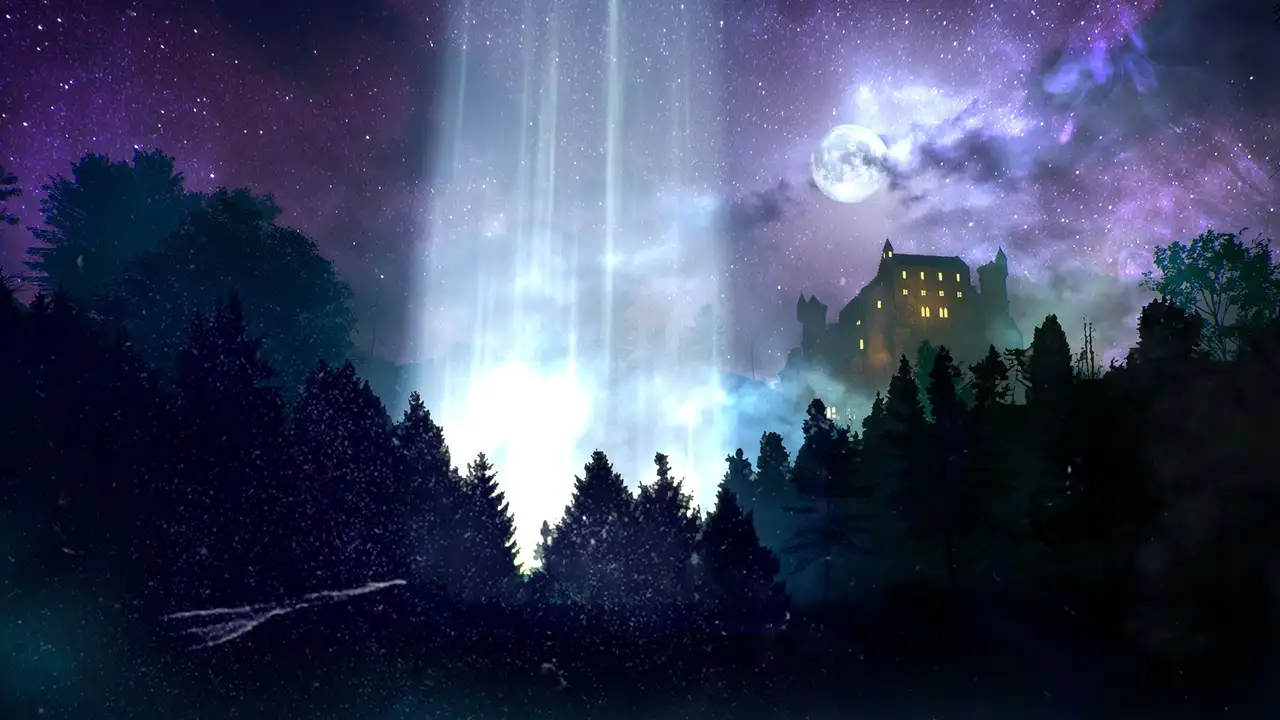
A princess and her mother are separately pulled into the land of Eldrich, where a scheming fairy plots to detonate the volcanic underground and destroy the realm. The story unfolds across six chapters alternating between the two leads, whose arcs run in parallel, one below ground and one above, and converge only in the finale. The tone is unashamedly animated-film: an opening musical number, a town convinced the sky is falling, a moon-theft trial sentencing the queen to the jellybean mines of a faraway kingdom with a deliberately silly name, and a troll court that balances pathos against punchlines. Nothing else in the line plays quite like it.
The dual-protagonist structure is the genuine novelty. Two separate characters with very differing stories give each chapter its own rhythm, and the underground and overworld perspectives complement rather than duplicate, making the six-act frame feel like episodes of a film rather than a single crawl. A callback to the fourth entry, revealing a onetime captive as the lost son of fairy royalty who then asks to court the princess, lands as the series’ warmest continuity payoff, and the happily-ever-after register suits the production’s ambitions.
Cel-animation presentation defines the look. Environmental detail steps up noticeably from the previous entry, with painterly backdrops and hand-drawn flair that no earlier chapter attempted, though the sprites themselves sit awkwardly against those rich backdrops and stick out like sore thumbs. The art direction divides between gorgeous scenery and mismatched characters, and the mismatch is noticeable enough to distract in busy scenes.
Chapter framing gives the whole production its rhythm. Title cards open each act like a storybook page, the alternation between the two leads builds anticipation rather than frustration, and each chapter’s cliff-hanger hands momentum to its partner’s thread. The underground realm’s volcanic menace and the overworld’s folk-tale nonsense complement each other tonally, one supplying stakes while the other supplies jokes. Convergence in the finale earns its payoff precisely because the two threads have been kept apart for so long. Few chapter-based adventures of the era managed pacing this deliberate.
The rhyme-speaking cast keeps the comedy flowing. A pawn-shop trader, a gravedigger and a skeleton court all speak in verse, the sky-is-falling panic town full of eccentrics earns its affection, and the tonal commitment to musical numbers and outright silliness is total. The gamble will not suit everyone, and the rhymes occasionally nonplus more than they amuse, but the conviction behind the Disney-fied register gives the entry an identity none of its siblings share.
Forgiveness is the design’s quiet revolution. Deaths are few, mostly optional or scripted, generous inventory items explain their own uses, and some items never find any use at all, a deliberate anti-soft-lock guarantee that marks the series’ pivot from cruelty to accessibility. Falling to a death by walking off a ledge is no longer possible, restoring is rarely necessary, and the whole adventure is beatable without a walkthrough, which for this lineage is a genuine departure. Puzzle-salve crafting, potion recipes, crystal-charging rituals and statue-and-rhyme-trader exchanges keep the item logic self-explaining throughout.
Friction sits at the frame. The desert opening loops an endless maze of identical screens until collapse, with no indication that a water-gift is the solution, nearly breaking the adventure before chapter two steadies the ride. The bookmark-based save system replaces the series’ save-anywhere norm with something opaque enough to feel absent, occasional pathing glitches let the princess walk through scenery, and slow-walk backtracking drags. Overall, a Disney-fied detour trades Sierra cruelty for accessibility without losing the fairy-tale heart, and its gentlest chapter remains one of the series’ most charming oddities.