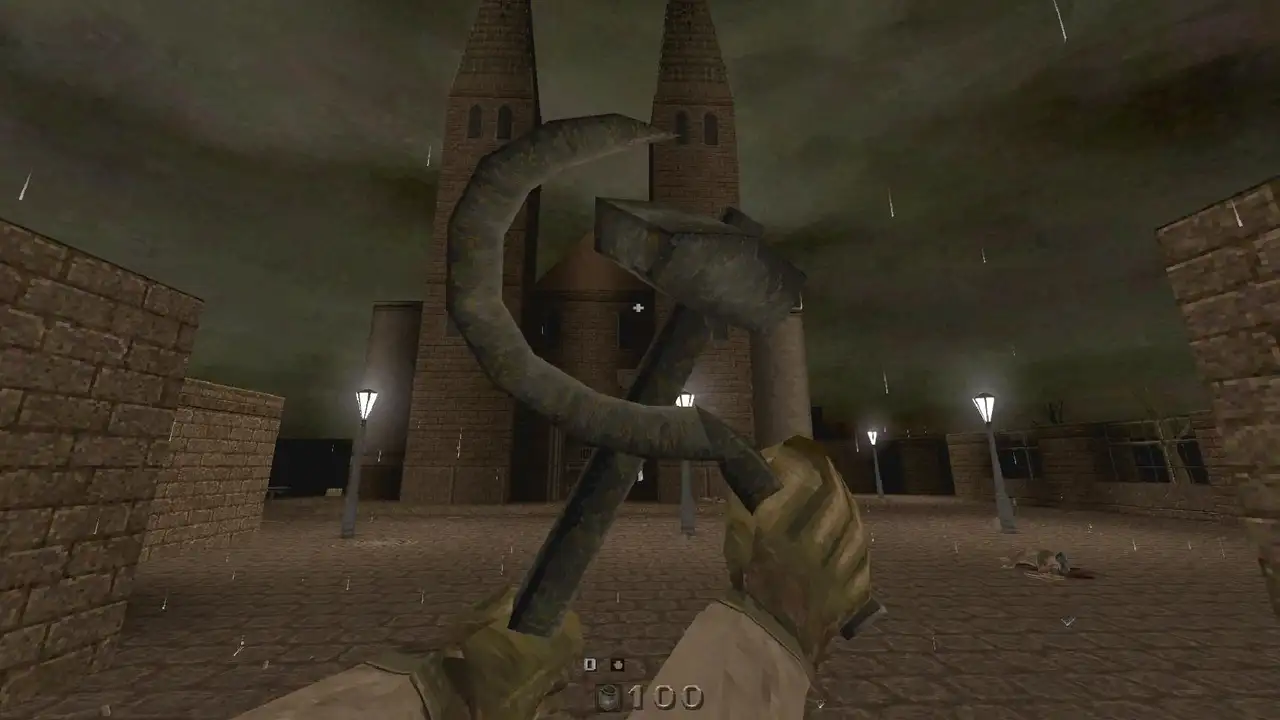
Brown has rarely looked this deliberate. HROT commits entirely to the grey-brown palette and fast fluid feel of a lost 1996 build, and the pastiche lands from the opening corridor through to the final pterodactyl-riding commander. The Czechoslovakia-flavoured satire seeps through every surface: Lenin propaganda posters that can be kissed, health-and-safety plaques, unlockable Czech recipes after each episode, a gas-masked horse and a cosmonaut goat in the bestiary, and an armoured vest with an unprintable name. The tone oscillates between complete lunacy and mild horror, and dark tunnels reliably become horror set-pieces, effective if slightly predictable by the end.
Gunplay is the foundation. The close-range shotgun kills in one blast and earns its place as the arsenal’s clear favourite, backed by a kick that punishes anything that survives, and a launcher-zoom trick hiding on middle click. Weapon feel stays smooth and punchy across all three eight-level episodes, and generous shotgun ammo keeps the brutality from tipping into frustration. Quick saves on F6 and F9 function as safe states, letting each ambush be attempted until it breaks.
The key-hunt structure anchors the level design. Rusty, silver, common and colourful keys open per-episode variants of the classic formula, switch-activated ambushes punish carelessness behind doors, and destructible scenery rewards shooting everything that looks shootable. Healing runs on wine and beer that actually intoxicate, karuna armour scraps patch up the damage, and a quirk where the health cap blocks pickups forces careful consumption. Levels stay short and punchy, which balances difficulty that is genuinely brutal on Normal, with spongy late-game enemies and low-health carry-over between levels.
Enemy design splits cleanly. Shotgun cultists, snakes, disappearing foes and, worst of all, floating heads that hurt and blind on contact draw real frustration, and spawn ambushes behind doors feel cheap even when anticipated. The bosses zigzag: a gorilla ambush opens the brutality, a gymnastics horse and a tank follow, and the digger station fight earns genuine admiration precisely because the boss only spawns enemies rather than attacking directly. That same design, applied to the Straov stadium’s wheelchair-bound spawner, sours badly; the worst enemy types pour out while the boss attacks directly, and the fight drags far past its welcome.
The hospital and ambulance gauntlet marks the campaign’s hardest stretch, an insane level that pushes the difficulty to its ceiling before the digger station immediately redeems the episode. Secrets run so well-hidden they border on invisible, a design choice that will exhaust anyone chasing full discovery, and a hatch leads to a secret level repairing the ordlage. The finale delivers a Supreme Commander-in-Chief on a pterodactyl, an absurd summit worthy of the campaign’s excesses.
The absurdist worldbuilding extends into play. A cheat-enabled pool table lets the game cheat back, interactive recipes reward reading, and the enemy bestiary documents headless roosters alongside the pterodactyl rider. All of it wraps around gameplay that genuinely plays like the era it imitates, without irony getting in the way of the shooting. The three episodes total around six hours, brief by the genre’s standards but dense with gags and ambushes.
Overall, HROT is a fast, bizarre and brutal retro shooter whose committed brown aesthetic, sharp gunplay and genuinely funny Czech absurdism make it easy to recommend, with the shotgun-and-kick loop as its beating heart. Spongy enemies, floating heads, the overlong stadium boss and secrets tucked beyond sight sting, but the homage never loses its footing.