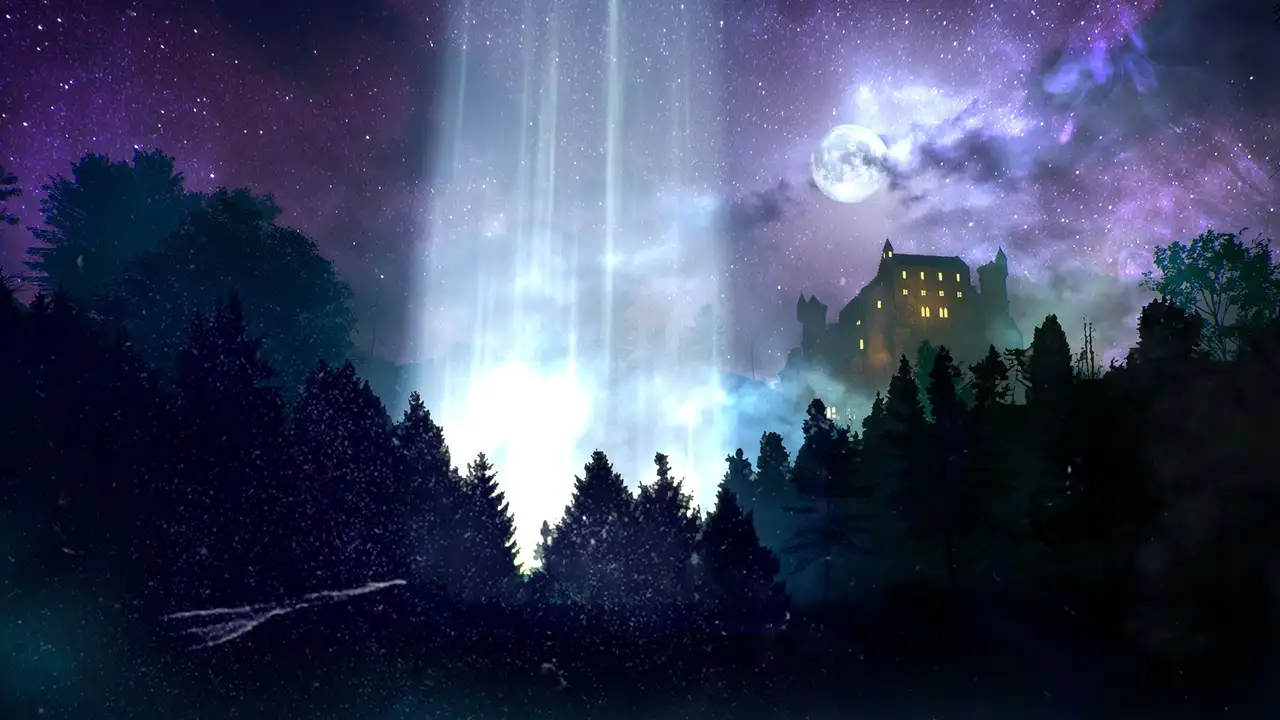
The walled floating metropolis of Aonis rises above a quarantined western Britain, a post-Brexit dystopia of orbital strikes, hover cars and broken promises from Sherwood Estate Management, and a stranded protagonist must navigate the ruins below to reach it. The setting gives the familiar survival-horror loops a register nothing else in the genre occupies, and the worldbuilding arrives through documents that genuinely land: resident letters, confidentiality memos, and the estate company’s self-serving notices. This is recognisably PS2-era in feel with visuals slightly beyond it, and the solo-developer feat behind the whole production (one person handling code, art, graphics and soundtrack) makes the coherence remarkable.
The Silent Hill lineage is the game’s soul, worn openly rather than apologetically. The item-pickup jingle, red-flash save rooms, apartment-block settings, a wooden bat embedded in a door, and a grappling protagonist all trace the lineage precisely, and the homage extends to a creepy phone-line stranger dispensing cryptic encouragement. Recognition deepens as the apartment block gives way to streets and the parallels to the inspiration’s most famous entry accumulate. Crucially, the homage never tips into cloning: the sci-fi quarantine frame, codec calls and nanotech repair sprays keep the identity distinct.
Classic survival-horror structure underpins the exploration. Key and fuse-box progression, light environmental puzzles and a small bestiary of dogs, crying humanoid creatures and a relentless spiky pursuer fill the streets and blocks. The birthday-date safe code rewards genuine deduction, and enemies escalate after the first kill, spreading to areas previously safe. Stomp finishers reward closing distance with melee weapons, and burnable enemies hint at a mechanic deeper than the campaign requires. Health states (fine, caution, danger) keep the pressure honest at roughly three hits from death.
Combat balance is the weakest system. Revolver ammunition is so plentiful that tension evaporates, with stockpiles climbing past ninety bullets in a campaign that never demands them, while the spiky pursuer chases relentlessly regardless of distance. The late bow and arrow is absurdly overpowered, felling in five shots what a shotgun barely dents, and the swing between abundance and imbalance means combat never settles into rhythm. Burnable enemies go unexplained, their trigger never surfacing in normal play.
Mid-game street navigation is the friction point. The maze-like layouts offer few waypoints, one wrong turn leads to doubling back on foot, and the disorientation compounds in the rain and dark. Fixed cameras fit the period aesthetic but produce at least one jump-scare stumble from an unseen angle, and a flashing diagnostic device plus assorted interactables lead nowhere, puzzling without payoff. Tank controls are available and best ignored; the modern scheme serves the fixed angles well.
The atmosphere deserves separate accounting. Constant rain, dark apartment blocks, heartbeat audio and a soundtrack of industrial unease sustain dread between fights, and the late-game turn toward the surreal (a glowing tree, a phone call that puts the caller on hold) lands as genuinely affecting rather than absurd. A phone-choice branching point implies multiple endings, and the closing sequence earns its melancholy without overplaying it. The tone walks between dystopian science fiction and psychological horror without stumbling.
Post-completion unlockables reward finishing: a dungeon-crawl mode, a first-person perspective and a big-head mode, a generosity that puts full-priced productions to shame. Combined with a compact runtime and the implied ending variety, the structure invites a second pass in a way most modern horror does not. As a follow-up to Chasing Static, it confirms a shared universe (the hazmat-suit callback is there for those who know) and a developer worth following.
Overall, this is a loving, competent Silent Hill homage whose atmosphere, art direction and document-driven worldbuilding far outweigh uneven combat balance, maze-like street navigation and a bow that trivialises the arsenal. The post-Brexit quarantine setting gives the pastiche an identity of its own, and the whole amounts to a short, memorable love letter that honours its inspiration without merely imitating it.