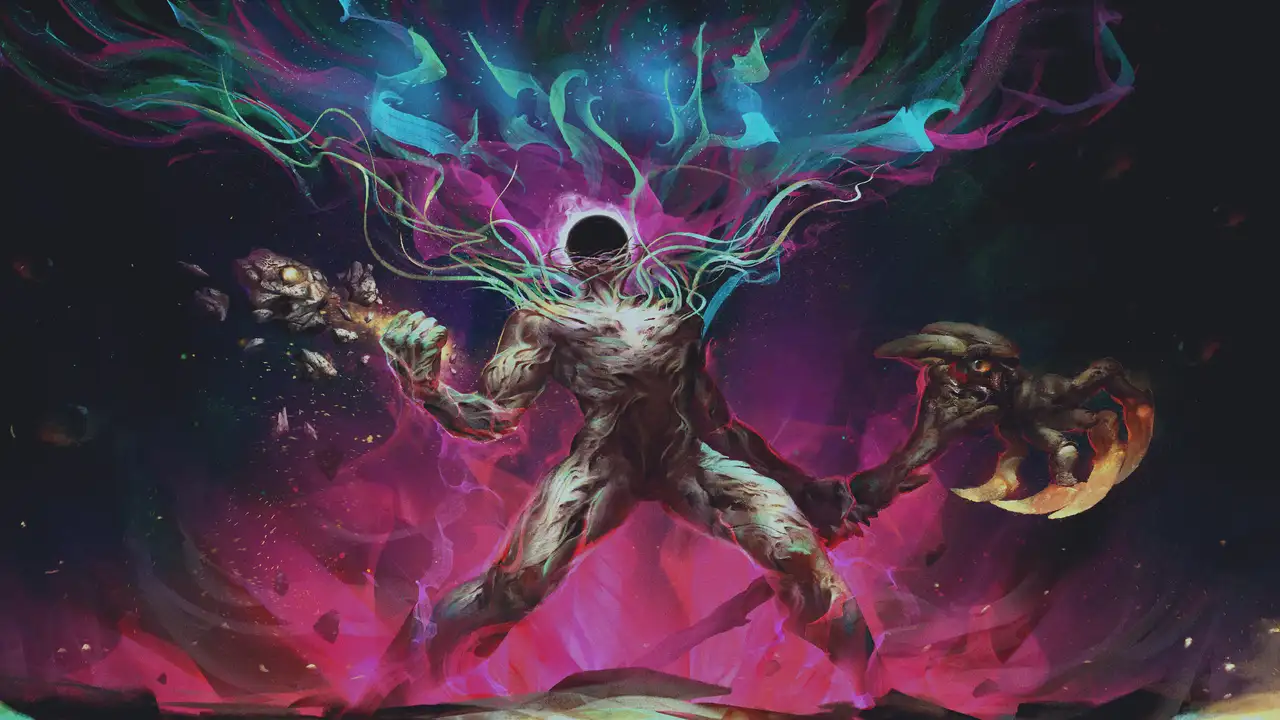
Silence does more work than music in GRIME. The soundtrack is sparse by design, and the quiet puts every distant thud and whispered voice on edge, which suits a world of stone-born creatures, whispering mothers and the Carvers of a broken world pillar. The grotesque flesh-and-stone art direction seals the register, and the protagonist, a silent black hole wearing a rock body, gives the whole enterprise a premise few contemporaries touch. From the opening minutes the presentation alone marks this apart from its genre peers.
Absorbing is the signature. Parrying an enemy attack does not merely negate it; the attack is swallowed, converting into breath that funds healing and force, and repeated absorption unlocks traits drawn from the prey itself. Against bosses the system borders on absurd in the best way, turning the most dangerous moments into the most rewarding ones. The breath economy rewards aggression in a genre that often rewards caution, and the loop of risk, absorb and spend never loses its charge.
Pulling flows from the same black-hole identity. Objects, enemies and even the protagonist through self-pull anchors get yanked across space, and what begins as a forgettable trick becomes the centrepiece of a whole build once the damage on pulled targets is understood. Dash, air dash and hover arrive along the ability-gated progression, each opening fresh routes through the interlinked biomes. Every tool is justified by what the protagonist is, which gives the kit a coherence rare in the genre.
Child Bed is the low point. The area leans almost entirely on precision platforming challenges with checkpoints spread far too thin, and only the hover ability, earned elsewhere, makes its gauntlets tolerable. The vulture boss compounds the friction with attacks so unreadable that one swing does not register as an attack until contact. Elsewhere the difficulty balance is fair, with most bosses falling inside a handful of attempts and death costing only accumulated Arda rather than collected mass.
Surrogates anchor the progression as bonfire-equivalent rest points, generous in placement, while the Smith upgrades weapons and the trait system converts hunt points into build-defining perks. Exploration stretches across sprawling, interconnected biomes that rank among the largest in the genre, and the final discovery tally climbs into the mid-nineties without artificial padding. Fast travel exists, but the picture-only destination menu turns every warp into a guessing game, a Dark Souls-style choice that communicates nothing. Double jump arrives so late it barely matters, unlocking close to the game’s end.
Blind-spot design is the recurring annoyance. Enemies hide deliberately off-screen or at frame edges, and off-screen attacks punish without warning, cheapening otherwise fair encounters. The right-stick pull binding shares blame; a dedicated button would have served the mechanic far better, and the awkward input keeps the best tool underused even after it becomes essential. Neither flaw breaks the loop, but both are the kind of friction a player chalks up to design choices rather than challenge.
The narrative stays oblique and rock-quiet, delivered through item lore, the Dakota encounters, the doomed follower Yon and the dying-god framing of the Coda, and the finale’s city celebrating an appetite is a memorably strange climax. Shidra’s late plea lands with force, and the closing sequence rewards refusal rather than surrender. Story and system rhyme throughout, which is the game’s real achievement.
Overall, GRIME succeeds because its premise is load-bearing rather than decorative: absorbing, pulling and consuming all flow from being a living black hole, and every system honours that identity. Navigation friction, the fast-travel menu, the pull binding and Child Bed’s checkpoint drought sting, yet none of it dulls a confident, mechanically distinct metroidvania that holds its course to a satisfying close.