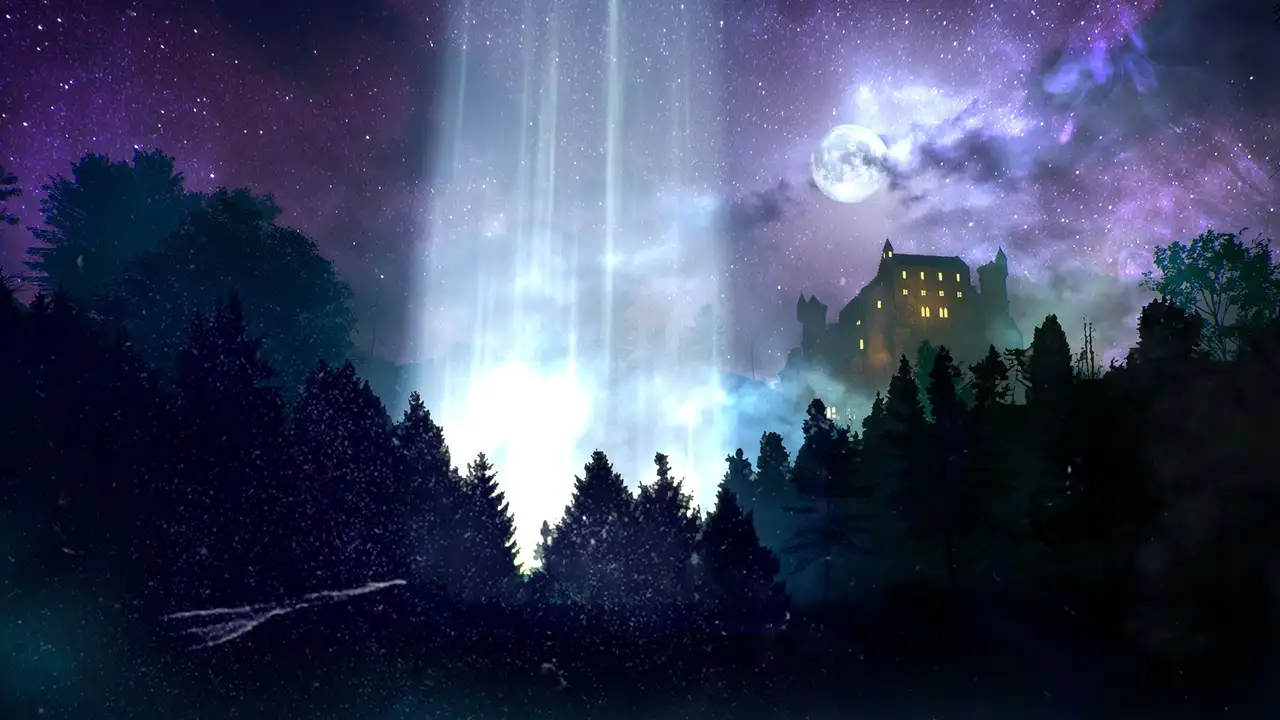
A fog descends over Tokyo and spirits its residents away, leaving a possessed visitor and a gruff spectral partner to reclaim the emptied city one soul at a time. The premise is melancholy rather than frightening, and the eerie atmosphere keeps getting punctured by cheerful, Shinto-flavoured systems that turn grief into a completionist playground. Environmental storytelling fills the gaps the thin plot leaves: hospital notes, missing-person letters and a piano-school corruption tale carry more weight than the main missions themselves. The mood is vibe over horror, and the city’s wet, reflective streets render beautifully enough to justify wandering without purpose.
Combat rests on three elemental finger-guns (fire, water, wind) plus a bow, telekinetic car-grabs and perfect-block parries, and the simplicity holds up across the whole campaign. Basic as the kit is, the elemental weaving stays consistently fun, and enemies that deflect or flee, wall-walking invisibles and spinning attackers, force variety on encounters that could otherwise stagnate. Blocking is the mechanical weak point, with awkward timing windows that never quite click. Endgame bosses underwhelm badly, trivialised by an over-levelled build long before the credits arrive.
The collectathon is the heart of the design and the reason to stay. Souls scattered across rooftops, alleys and corruption nests feed a phone-booth deposit loop and a map percentage that ticks with every clearing, and the density is obsessive: Yo-kai hunts, Tanuki hide-and-seek, kappas fed cucumbers, prayer beads, Jizo statues and a thousand-man spirit hunt. Spectral vision, tracking helpers and map filters make the game exceptionally friendly to collectors, and the dopamine of a completed region is genuine. Animals are pettable everywhere, a small feature that cements the whole personality.
The Spider’s Thread update roughly doubles the game. A new district, new enemies, side quests and collectibles raise the completion target while making 100% easier relative to the enlarged pool, and its school quest delivers the most horror-flavoured content in the package, distinct from everything around it. Side quests across the base game are varied and consistently exceed open-world expectations, each one playing out differently. The update alone justifies revisiting a game many already wrote off.
Traversal powers the loop but misfires at the edges. The Tengu grapple is great when it works and a nuisance when it doesn’t, failing mid-glide and on awkward curved rooftops often enough to make long climbs feel like gambling. Early-game fog barriers and invisible walls railroad exploration before the map opens, and rooftop enemy placement feels arbitrary, spawning spirits in spots that feel missed rather than hidden. None of these break the loop, but the friction is felt most precisely where the collectathon demands repetition.
Structural quirks accumulate around the margins. The spirit counter only updates after a phone-booth deposit, making completion tracking needlessly fiddly, and the shrine offering-box prayers never explain what they mechanically do. A vault-suit crossover outfit is a strange publisher artefact, and the skill tree’s magatama gating sends hunters chasing Yo-kai long after max level. The main story, completable in around six hours, functions as scaffolding for the side content rather than a destination, and its emotional payoff lands despite the thin lead-up.
Overall, this is a joyful completionist playground whose folklore-soaked density, three-element combat and generous collection tools make it one of the most rewarding open worlds to fully clear. Temperamental grappling, awkward block timing, underwhelming bosses and a fiddly spirit counter are real irritations, and the main plot is brief scaffolding. The map-clearing loop and the city’s beauty carry everything else, and the whole remains well worth sinking relaxed hours into.