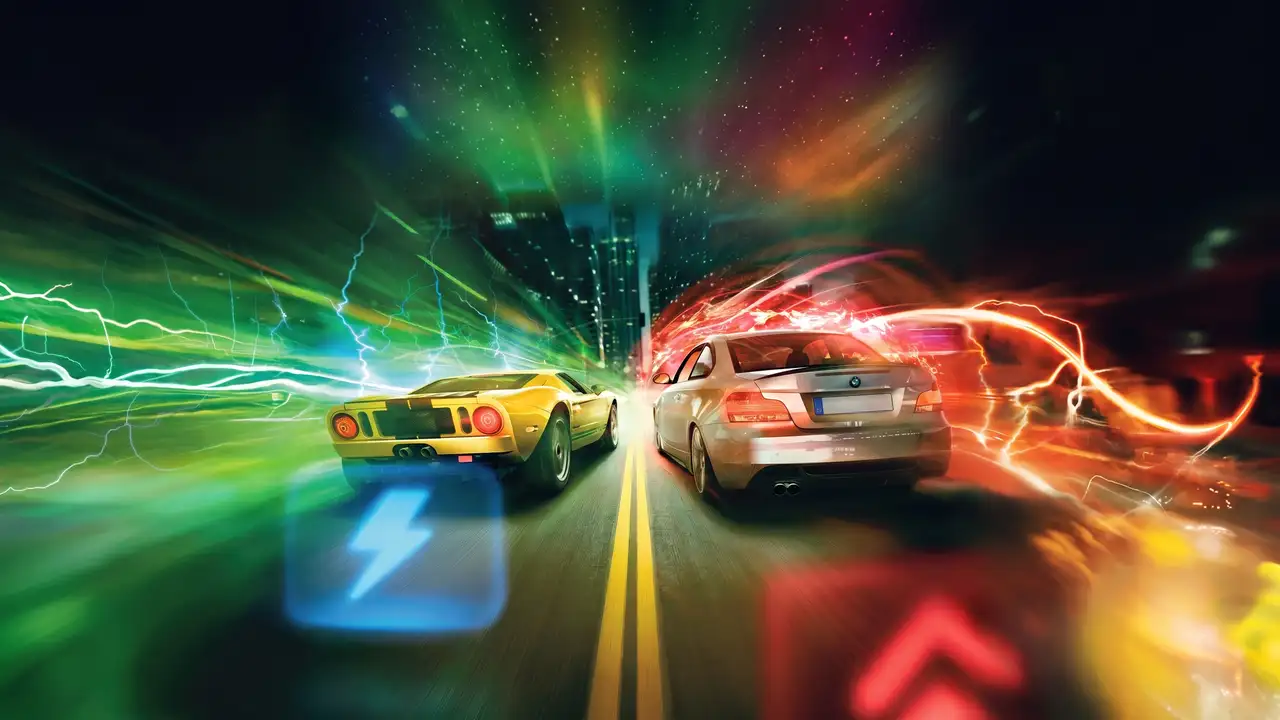
A roaming music festival takes over a stretch of Colorado, and the racing carnival built around it (radio DJs, superstar rivals, wristband ranks) gives this open-world racer an identity no contemporary competitor attempted. The reigning champion rules the festival with theatrical menace, and his banter with the upstarts chasing his crown is repetitive but consistently funny. Colorado itself is the star: a varied map of mountain roads, dry lake beds and vineyard straights where surface choice and car selection genuinely matter. Eighteen or so hours to full completion speaks to how much content the festival packs into its sunshine.
The core racing leans arcade and benefits from it. Crash physics are forgiving enough that reckless driving never penalises, a design choice that keeps scrappy pack races fun rather than punishing, and the braking-only driving line teaches the routes without demanding simulation rigour. Class-restricted events force genuine car variety, with some limiting to all-wheel drive and others to million-credit exotica, and the rotation keeps the garage relevant. Event types (circuit, sprint, street race, showcase, speed traps, drift) layer onto the wristband progression steadily, and showcases against planes and hot-air balloons deliver the festival’s most memorable set-pieces.
The surprise of the campaign is a humble rally saloon. Bought first and expected to serve as early transport, it turns out to dominate nearly every class it enters, kicking exotic supercars aside in the top-tier events, and the underdog story it writes across the run is a genuine delight. The endgame exotic with tens across the board finishes the job, winning the climactic showdown by two seconds in a sub-seven-minute final. Car hunting in this game rewards curiosity over chequebooks, and the best car in the field is not the one the showroom advertises.
Track reuse is the campaign’s structural disappointment. From the purple wristbands onward, circuits repeat with growing frequency, and the championship final turns out to be the exact same track as two prior races, undercutting the climax with familiarity where a point-to-point sprint would have landed harder. The final showdown itself delivers real tension once it clicks, but AI inconsistency sours the attempt: rivals shoot off after the player’s mistakes while recovering instantly from their own, forcing perfection in races that should reward speed.
The rally expansion is welcome content in bare-bones form. Each recycled map route runs forwards and then reversed, no weather effects appear anywhere, and the minimap invalidates the co-driver whose pace notes go untranslated unless the jargon is already familiar. It is close enough to rally to be fun and far from the discipline’s simulation depth. Worse, the expansion broke outright: the seventh rally’s track loaded with the car suspended in mid-air at the same spot across two attempts, freezing the run short of completion. Going out on a freeze is a whimper no expansion deserves.
Completionism carries its own friction. Barn finds gate behind raw distance driven rather than event progress, so fast-travel enthusiasts can finish the game at 100% in every other category with barns still locked, an odd design that punishes efficiency. No reset-car button exists, making the long final showdown punishing whenever scenery traps a wheel, and cockpit view’s wobbly camera disorients at speed. Sprints drop the driver at the finish rather than the start, a small navigation annoyance that accumulates across a full run.
Overall, this is a landmark open-world racer that holds up as pure fun, with festival identity, forgiving arcade handling and a varied map outweighing its reused back-half tracks, rubber-banded rivals and a broken rally expansion. Barn-find gating and the missing reset button add small irritations to a completionist run. The whole still delivers the breezy freedom the festival promises, and the underdog saloon alone is worth the price of entry.