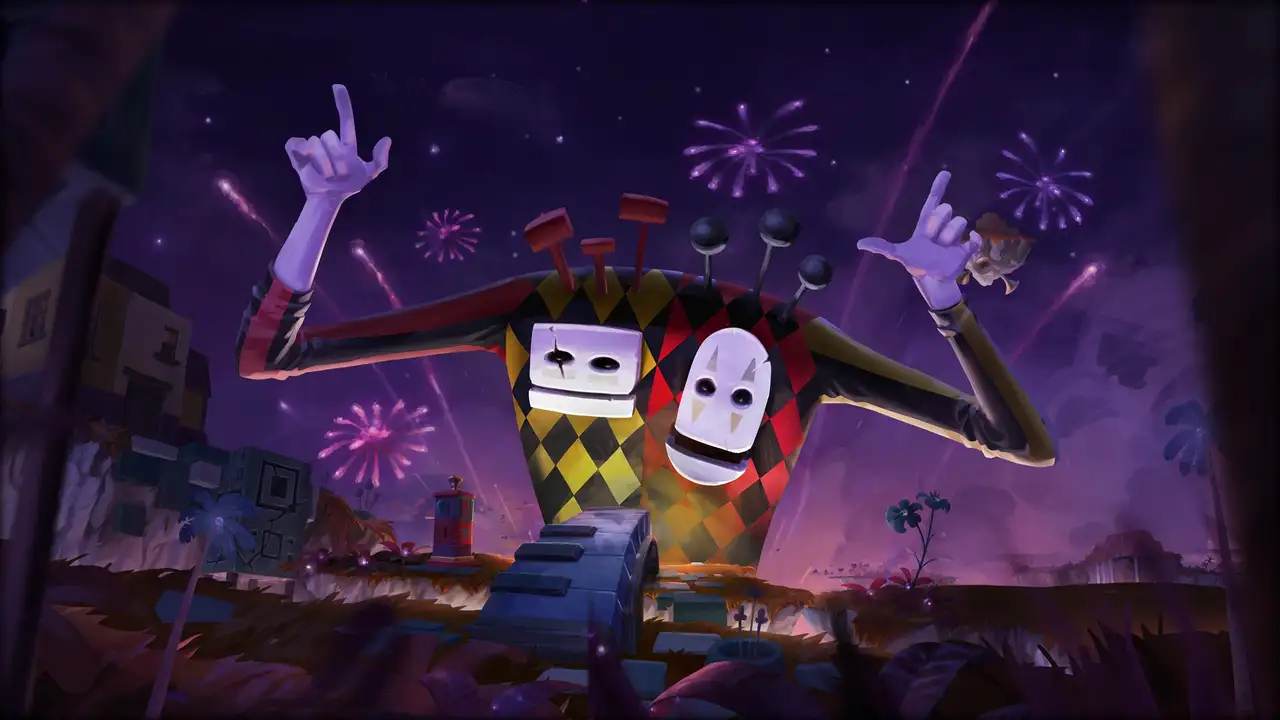
Inside a human mind, courage and a logic bird descend into Creed Valley, where a twisted moral compass and a jester nightmare have thrown the psyche off balance, and the whole conflict plays out as musical theatre. Opinions sing their biases, bosses take the stage as literal performances, and the melancholic real-world frame, a workaholic father missing family milestones while buying a house, grounds the whimsy. The pencil bridges and thought-block world-building turn suppressed ideas into architecture, and few games fuse song with puzzle adventure this thoroughly. It is a sequel with a clear identity of its own.
The music is the reason to visit. Original numbers punctuate every chapter, opinions harmonise their prejudices, and the Ditch’s discarded-beliefs song stands out as both the score’s peak and its most pointed piece of writing, cutting closer to real life than the surrounding whimsy suggests. The songs justify replaying the soundtrack long after the credits, and each one lands as a set piece rather than background decoration. Stages double as instruments, and the art direction paints the mind’s clutter in storybook pastels that keep even the ugliest corners watchable.
The detective-mystery section delivers the campaign’s unexpected structural highlight. Ruling out weapons, times and suspects in a journal via the Rationalizer plays as a compact courtroom whodunit, and the deduction quest slots into the mind-scape without breaking its rules. The Black Hog spotlight boss, the ethics maze with its pattern trials, the cardinal-stone hunt for compassion, wisdom, justice and integrity, and the cage-trap plan that backfires round out a varied chapter list. The open/closed-minded switch rewires which paths and behaviours the world offers, a mechanical metaphor that earns its theme.
Combat is the weakest pillar. Serviceable but shallow, it turns chaotic whenever multiple cannons crowd the arena, and the finale piles up far too much to track at once. The jester chase sequences are the roughest stretch, overwhelming and punishing, with visual clutter pushing the difficulty spike well past the rest of the game’s register. Compared with the first game the whole structure is simpler and more straightforward, which smooths the flow but thins the puzzle depth, leaving battery-colour socket puzzles as the main mechanical diet.
Rough edges dot the presentation. A text-colour bug turns dialogue blue partway through and never explains itself, and the two-player co-op mode remains genuinely puzzling in how it could function given the design. Collectibles such as memories and shards are signposted vaguely enough that completion is a chase rather than a given, and the listed playtime oversells the length by a comfortable margin. None of these dents the core, but the polish sits a notch below the ambition.
The jester’s reveal recontextualises the entire antagonist. Locked out of its own bullhorn-barricaded fun house, the nightmare is a silenced part of the mind that wanted only to be heard, and the resolution comes through dance and restoration rather than destruction. The landing is genuinely moving, and the sympathy it earns is the story’s smartest trick, turning a boss into an apology. The closing stinger resolves the real-world storyline with warmth.
Overall, Figment 2: Creed Valley is a charming, song-soaked mind-dive whose original numbers, literalised-opinion cast and moving jester reveal more than compensate for shallow combat and thinner puzzles than its predecessor. Chaotic finales, a text-colour bug and opaque co-op are honest costs, and the heart wins the trade.