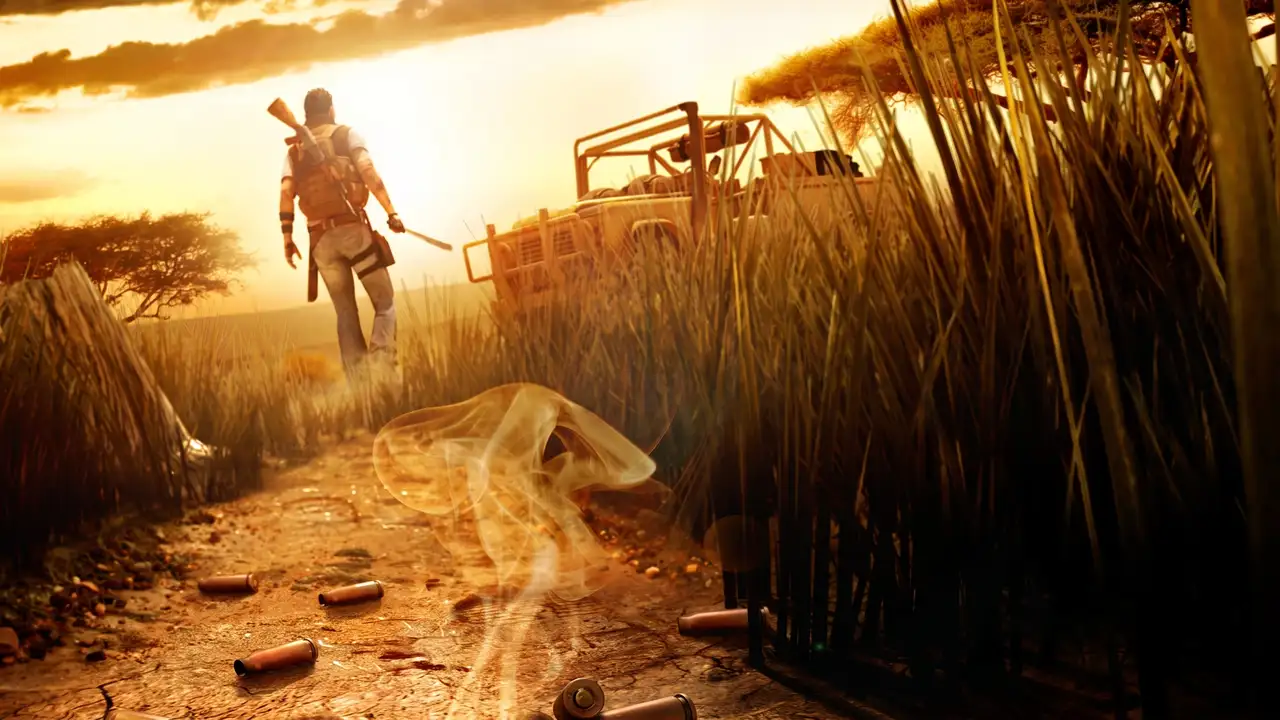
Mercenary cynicism saturates every kilometre of this war-torn, unnamed African country, where two factions grind against each other and malaria is as much an obstacle as gunfire. The premise refuses comfort from the outset: weapons rust and jam mid-firefight, a blood-malaria meter demands pill management between skirmishes, and the diamond economy underwrites every purchase. Few open-world shooters of its era commit this hard to friction, and fewer still make that friction the point rather than a flaw.
Guard posts anchor the traversal loop. Every crossing risks a chase, every cleared checkpoint invites reprisal, and scouting at night with stealth becomes a genuine tactical layer rather than a novelty. Capturing safe houses converts hostile territory into usable ground, and the vast savannah maps make driving, gliding and on-foot infiltration all feel like deliberate choices rather than filler.
The diamond cases scatter across both maps in the dozens, and hunting them all is the only route to affording the full shop arsenal. That self-directed goal restructures the entire campaign: roughly half of a full run can be spent sweeping ridgelines, camps and rail yards for briefcases, and the shop’s diamond pricing makes every found case feel like earned progression. Completion here is a commitment, and the game honours it with the only meaningful currency in its economy.
Buddy rescue defines the stakes. Allies exist out in the world rather than only as mission tokens, they can be lost permanently, and losing every rescue-ready friend transforms late-game regions into something far bleaker. Dead buddies take their missions with them, the endgame restructures around who survived, and the system’s permadeath consequences give the campaign a body count that most contemporaries avoided entirely.
Mission design rarely rises to match those systems. Main objectives and side work alike reduce to go somewhere, kill someone, or find and destroy an item, and the repetition surfaces quickly across a long campaign. Faction reputation and mission-statistic tracking behave opaquely at best, counts that refuse to add up undermine trust, and the ceasefire zone can flag violations without any actual incursion.
The glider-gated diamond near the rail yard stands as the collectible hunt’s lowest point, a tight approach with unseeable enemies and repeated deaths that no other case approaches. Fast travel remains limited to bus stops, forcing long re-crossings of already-cleared ground, and the relentless respawn aggression compounds every journey. Weapon variety thins by design too; a preferred loadout settles early and most of the shop’s arsenal never earns use.
Story delivery leans on propaganda radio, faction leadership betrayals and a journalist’s arc across both sides, with the diamond-and-malaria cynicism doing the tonal heavy lifting. Narrative influence stays shallow, choices ripple less than the faction structure implies, and the writing knows it. As atmosphere rather than authorship, it works: the world’s hostility is its own argument.
Technical performance deserves its own note, because a 2008 release this ambitious runs remarkably cleanly on modern systems with no meaningful compromise. Stability held across a full campaign of long drives, dense firefights and rapid respawns, and the visual direction of sun-bleached savannah and dusk-lit compounds has aged better than most of its contemporaries. Friction here comes from design decisions rather than engine faults, which keeps the criticism aimed where it belongs.
Some smaller irritations persist alongside those deliberate ones. A permanently missable ally can vanish in the opening act without warning, leaving the mid-game shorn of support through its hardest regions, and the game offers no mechanism to recover that loss. Mission statistics drift out of sync with reality, side-objective counts stall at numbers that make no sense, and none of it is explained in-game.
Overall, this remains a singularly stubborn piece of open-world design whose deliberate hostility is precisely what makes it memorable. The buddy system, the diamond hunt and the unforgiving sandbox hold up remarkably well, and the frictions read as intent rather than age.