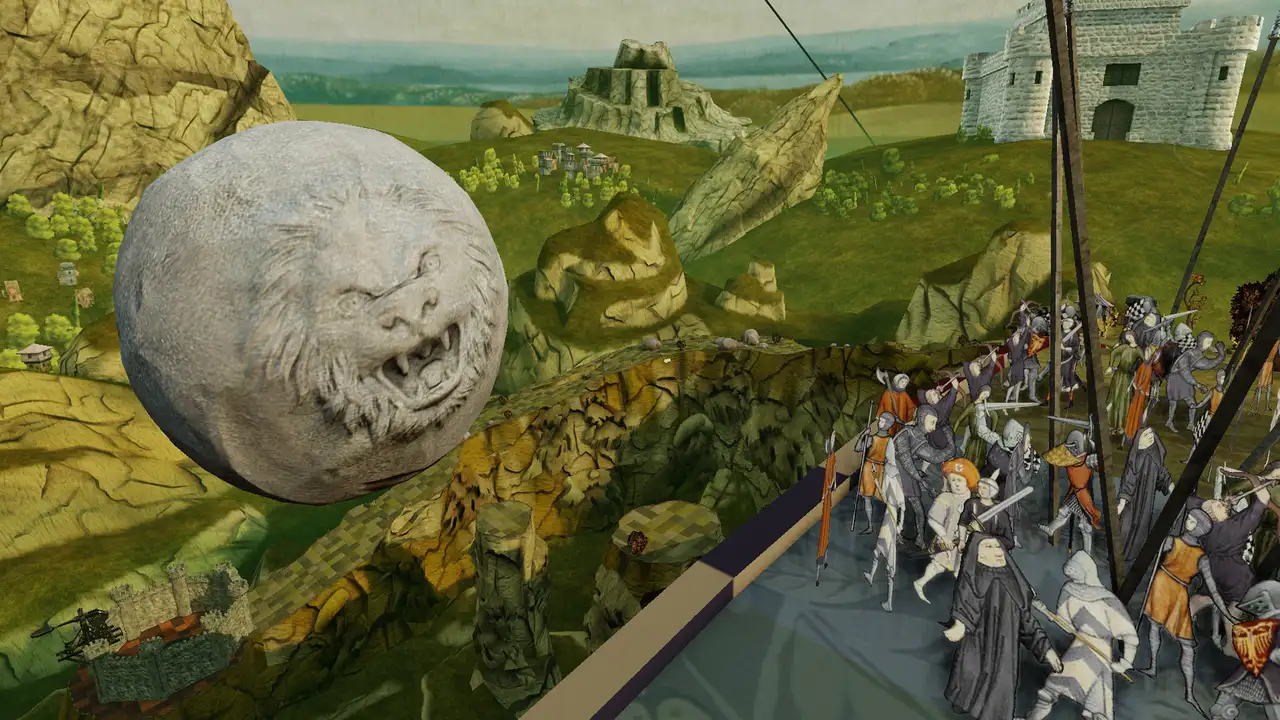
Captured after the first game’s events, the hero escapes a POW camp and journeys across snowy mountains, jungles, deserts and blood-soaked peaks hunting the Thongs of Virtue, and the sequel swaps swords-and-sorcery for a wartime comedy lens that gives it an identity the original lacked. Nazi-era orcs, undead potatoes and Jurassic dung quests establish the absurdist register immediately, and army gear, cannons and firearms complete the genre mash-up (loot RPG crossed with adventure-comedy and war parody) that nothing else replicates. The writing remains the series’ calling card, and the sequel keeps every joke landing.
Quest density is the structural strength. Dozens of multi-stage errands (cannons, mating glands, mailbags, foreclosure notes, bacon rocks) keep the loop fresh across the whole campaign, and the comedy of the quest premises does as much work as the dialogue. Cunning-plan soldiers, erotic documents serving as orc identification and fool’s bacon supply the absurdist texture, and quest dialogue sustains the humour where lesser comedies would deflate. Completing essentially everything is achievable and, unusually, enjoyable.
Guns change the combat formula for the better. Pistols, bazookas, flamethrowers and a laser gun layer onto the hack-and-slash loop with a justice meter, and the ranged options give fights a spatial dimension the melee-only original never had. The bazooka from a safe distance becomes a legitimate tactic, and grenades round out the arsenal. The wartime theme and the firearms are the same design decision viewed from two angles, and both land.
Gear progression churns constantly through named equipment sets (Spartan, Greatest Generation, Great White North, Desperado and Terrible Lizard), giving the loot loop its upgrade rhythm up to a max level of 21. Fortune-cookie hints supplement the quest log, though their accuracy is inconsistent: they sometimes point the right way and sometimes mislead, as with the battlements whose location the hints never actually revealed. Currency display adds minor confusion, with dollar-bill pickups initially reading as circuit boards.
Early backtracking is the pacing drag. Without fast travel until the outhouse network and the late ship unlock, the first half involves repeated retracing for cannons, notes and quest turn-ins across large maps, and the external-guide temptation is real. Ranged enemies compound the friction: gun-wielding foes hit harder and far more accurately than the first game’s melee mobs, and their bursts punish careless approach. Both problems ease once the ship arrives, which retroactively makes the earlier errands feel longer than they should.
The ship and island exploration finale restructures the endgame. Unlocking the boat opens island-hopping that turns the remaining quests from slogs into quick runs, and the observation that earlier quests only took as long as they did because the ship was unavailable is the design’s own confession: the fast-travel gate arrives one act too late. The X Island treasure-map finale yields sixteen dollars for the whole expedition, an anticlimax that at least lands as a joke, whether or not it was intended as one.
The WWII-flavoured setting shift keeps the sequel distinct from its predecessor without breaking the continuity of tone, and the humour is consistent enough that the formula never sags. Combat depth is modest and the challenge mild, but the package never pretends otherwise, and the completionist tail is genuinely satisfying rather than obligatory. As sequels go, this is the kind that changes exactly enough to justify itself.
Overall, this is a worthy, joke-dense action-RPG sequel whose comedy writing, gun-layered combat and quest variety justify the return trip, despite early backtracking without fast travel, brutal gun-wielding enemies and a thin treasure-hunt payoff. It doubles down on humour and content in equal measure, and the wartime lens makes it the series entry that stands apart.