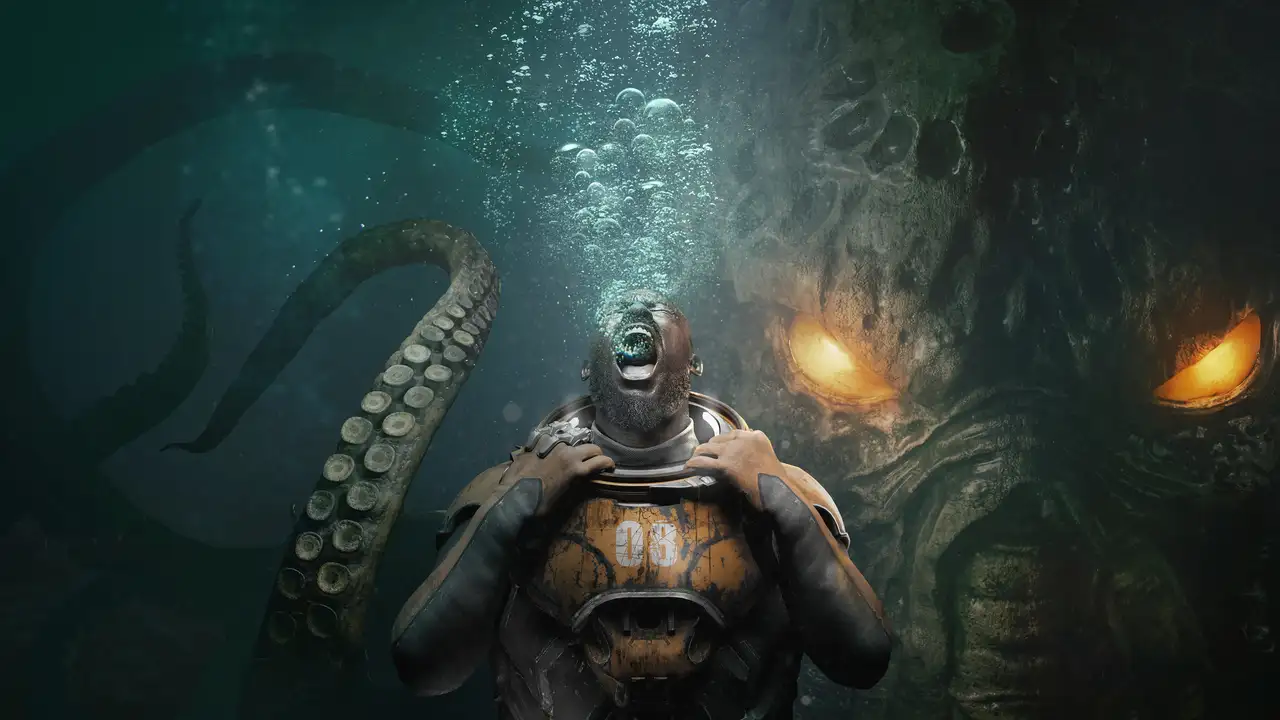
An engineer’s routine repair call to a derelict planet-cracker becomes a fight for survival, and the opening frames the whole campaign as a big misunderstanding: a distress signal answered in good faith, a crew split by bad information, a ship already lost. The intro sequence is a masterclass in setup, letting the dread accumulate before the first real threat appears, and for a 2008 release it still holds up remarkably well. The conspiracy underneath (a church, a government, a marker and a crew member’s messages that grow steadily stranger) gives the horror a spine beyond simple monster-slaying, and the reveal still lands even for players who have seen it coming.
The plasma cutter remains the best weapon in the game, and a single-weapon run is as viable as ever. Focusing on one tool concentrates the upgrade economy: with nothing else to spend on, credits pile up, the rig and suit upgrades max out early, and the cutter becomes a precision instrument for the dismemberment system it was designed around. The resource balance rewards commitment rather than punishing specialisation, and stasis and kinesis modules round out a kit that stays satisfying across the whole campaign. Six unlockable suits, power-node upgrades and a Z-Ball minigame give the Ishimura’s decks extra texture.
The survival-horror atmosphere is still the series’ best. Dark corridors, zero-G disorientation, the creepy lullaby drifting through the medical deck and the constant expectation of something bursting from a vent keep the tension high throughout, and the baby enemies remain the most annoying threat in zero-G sections precisely because they exploit that disorientation. Chapter 4’s brute introduction is a genuine highlight, the first real boss arriving exactly as memory places it and remaining effective as a set-piece. The dread here is the thing the later, more action-oriented sequels traded away, and revisiting makes the trade obvious.
Stasis design differs from what the sequel would build: no natural regeneration, but recharge points scattered generously through every chapter. The trade-off is genuinely arguable, since the abundance of recharge stations largely compensates for the lack of regen, though the balance tips toward friction in extended fights where a depleted stasis meter leaves the player vulnerable. Kinesis speed is fine for combat but slightly sluggish during the final marker-loading puzzle, a small pacing dip in an otherwise well-judged finale.
Friction is minor. Corpses occasionally get stuck to the player, a body-pickup glitch that is funny rather than frustrating, and early chapters delay store access until the end of the chapter, leaving the inventory overstuffed precisely when the player has the least capacity to manage it. The UI contributes its own small confusion with an “objective inactive” message whose wording puzzles rather than clarifies. None of these issues threaten the experience, and all feel like artefacts of the era rather than design failures.
Pacing deserves credit as quietly as atmosphere earns it loudly. The ten-to-twelve-hour run never pads its stay, chapters alternate combat arenas with quieter resource stretches, and the escalation from maintenance corridors to the marker chamber feels inevitable rather than arbitrary. The USG Ishimura itself is the campaign’s best character, its decks telling the story of the disaster in environmental detail: barricades, scrawled warnings, blood trails and the silence between them. Few locations in the genre have ever been this legibly hostile.
Overall, this is a tense, well-paced horror masterpiece that still delivers more than a decade on: the masterfully staged intro, the dread-soaked atmosphere and the eternally reliable plasma cutter earn the game its special place in the survival-horror canon. Delayed store access, occasional glitches and confusing UI wording are minor blemishes on a campaign whose commitment to dread the series never fully recaptured. It remains very much worth playing, and worth revisiting.