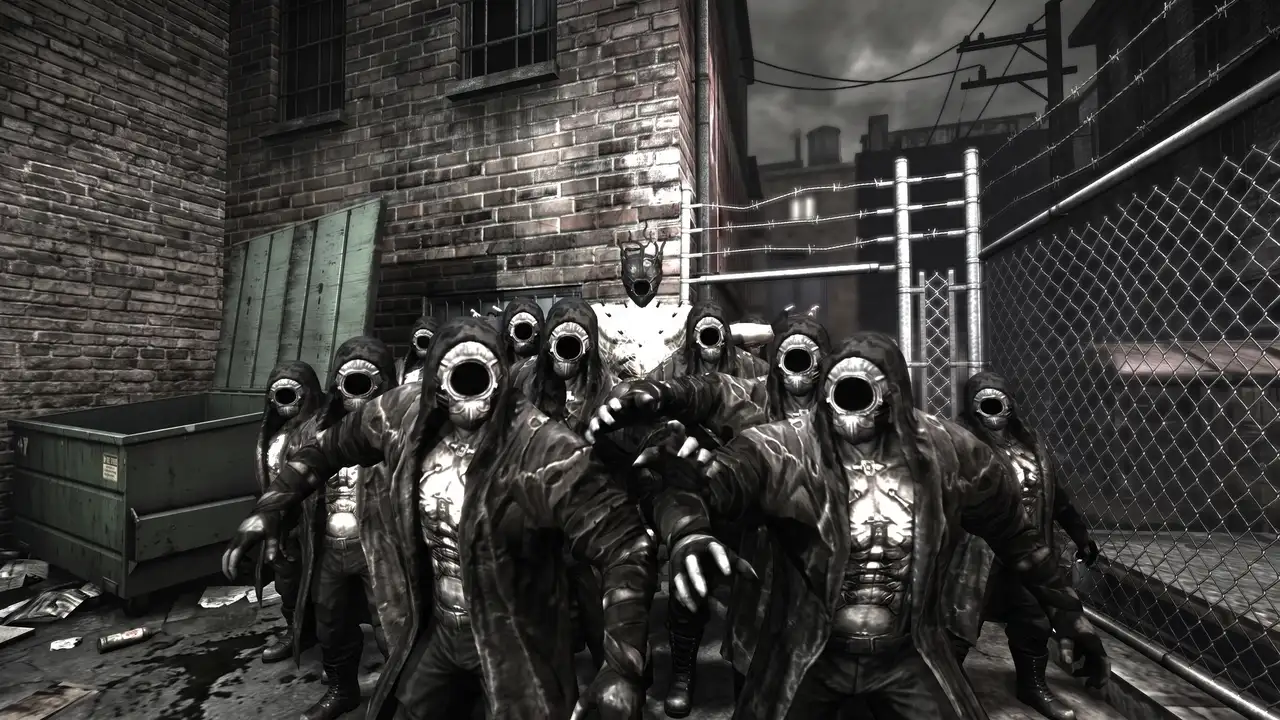
A dark, crime-ridden city frays into madness, and an FBI agent framed for murder stalks a killer-of-killers through subway tunnels, a department store, a burned library, a school and a rural orchard. The forensic-horror hybrid is the game’s signature: crime-scene investigation with UV lights and spectrometers stitched directly to grimy first-person club fights, a combination nothing else from its era replicates. Hallucinatory dread (mannequins that move when unobserved, enemies that vanish) sustains the atmosphere even when the outright scares stay restrained.
The melee brawling is the through-line. Breakable improvised weapons (pipes, fire axes, shovels, the humble paper cutter) each carry damage, speed, block and reach stats, and the weight of every swing lands with a grimy satisfaction that carries the whole campaign. The taser stun opens enemies for finishing blows, enemies kill each other in ways that border on slapstick, and hunting down the city’s deranged through ten chapters remains genuinely fun from start to finish.
Bart’s department store delivers the infamous mannequin sequence, and it lives up to its reputation even for players immune to mannequin phobia: figures move only when unobserved, display cases hide things better left hidden, and the section’s slow-burn tension is the game’s peak. The crawling enemies heard skittering along ceilings build more dread on approach than any other presence, though once confronted they fall as easily as any other foe, a gap between anticipation and payoff the game never quite closes.
The blocking system is the campaign’s most persistent frustration. It feels inconsistent and unfair across the entire run; blocks that should work simply do not, and the timing never becomes legible even by the finale. Slow default movement compounds the problem, making the brawls feel heavier than intended, and the forensic sections, while flavourful, offer collectibles (birds, metal pieces) that amount to little beyond achievements. The bird-death internal reports threading the citywide madness remain an intriguing side texture the plot never fully connects.
The riddle-puzzle orchard level restructures the final stretch into one extended environmental puzzle, a change of pace the grimy brawling benefits from, and the subway, library and school locations each carry their own sensory identity. The mystery escalates through hallucinations that blur what is real, and the serial-killer-of-killers pursuit keeps the investigation plotline taut even when the combat stalls. Sound design does heavy lifting throughout: distant screams, skittering above, and the crunch of every swing sell the city’s decay more than any visual does, and the comparison point of its era’s other horror shooters only sharpens how distinct this hybrid remains.
The final boss is the low point, and not through difficulty: a grab-shoulder prompt is bound to the number-1 key rather than the game’s usual interact key, an arcane binding that forces an internet consultation mid-fight. The PC port generally earns its rough reputation (missing files, no widescreen support, odd key mappings), but the fight itself, beyond that blunder, closes a mystery whose hallucinatory escalation lands as intended.
Overall, this is a very good, atmospheric cult classic whose scuffs never dent the verdict: the weighty melee combat, the forensic investigation loop and the department-store sequence carry it well past its inconsistent blocking and port nonsense. Two decades on, its grimy first-person brawling and unobserved-mannequin dread remain unlike anything else in the genre, and the mystery’s hallucinatory escalation still lands; dated presentation aside, the dread it builds endures.