An ageing bounty hunter holds court in an Abilene saloon in 1910, spinning an episodic revenge tale to patrons who keep catching his exaggerations, and the frame is the game’s masterstroke. The story visibly rewrites itself mid-mission: a listener disputes a detail and the level retracts, checkpoints announce the story’s revision, and set pieces transform to match the corrected version. Real Wild West figures (Billy the Kid, Pat Garrett, the Clantons, Doc Holliday, the Daltons, Butch Cassidy) weave through the fiction, and the narrator-versus-listeners interplay gives the campaign a structure nothing else in the western shooter space has attempted. It is interactive storytelling in a genre that rarely bothers.
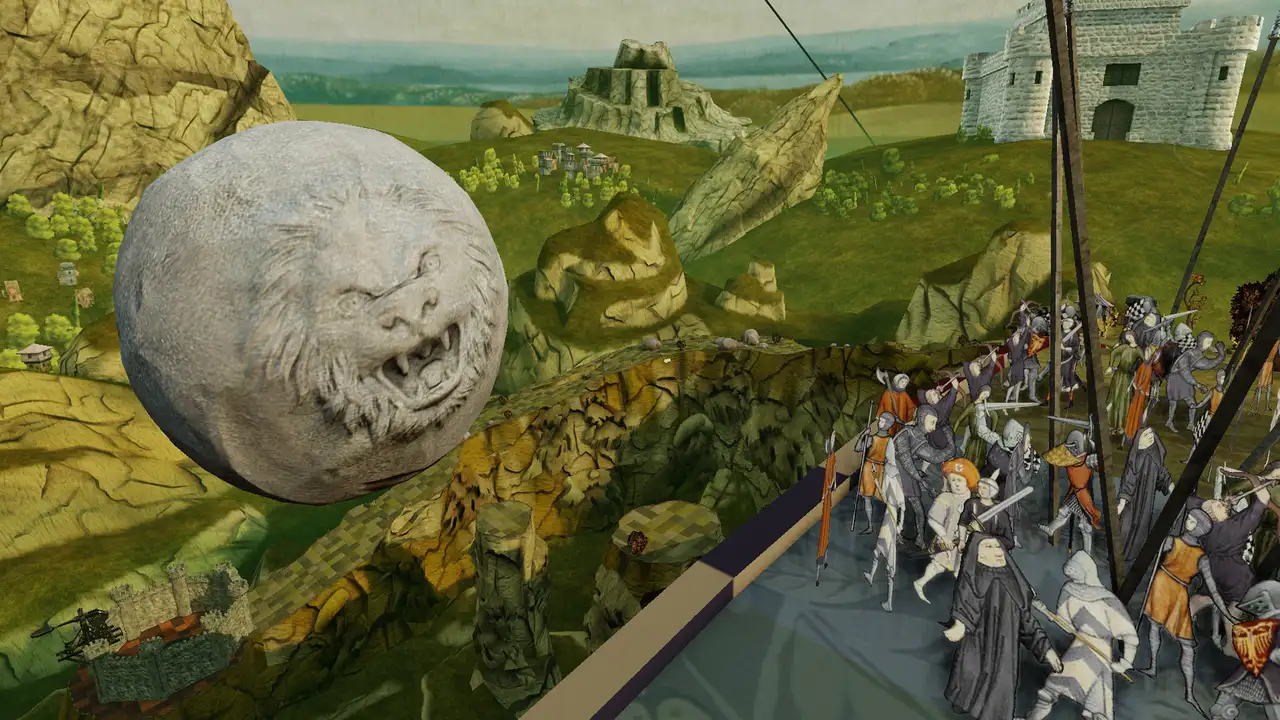
The cel-shaded art style is the other time-proof decision. Where photorealistic 2013 productions have aged into uncanny relics, the distinct visual identity still reads as deliberate and fresh, and character models in particular hold up remarkably. A flooded swamp, a burning steamboat and a hanging train bridge give the set pieces variety, and the compact levels stay inventive across the whole run. The aesthetic choice is a lesson in picking style over fidelity, and the game wears the lesson well.
The Nuggets of Truth collectible cards add a documentary layer that genuinely educates. Each card profiles a real historical figure with dates and portraits, and the information holds up to external fact-checking, an unusual claim for game collectibles. The darker passages, including sober coverage of the genocide of Native Americans, land with appropriate weight rather than decorative gloss. Scepticism remains healthy, but the layer transforms secret-hunting from busywork into something closer to a museum tour.
Combat is built on arcade systems executed with confidence. Dodge-based lethal-shot counters, concentration slow-mo, combo scoring and trick-shot duels structure the gunfights, and the skill tree offers genuine build choice across three branches: rifle ammo and long-range perks compete with dual-wielding and concentration upgrades, and mid-air dynamite splitting, a bullet-bounce armour perk and the golden rifle reward investment. Concentration itself is underpowered in practice, with the gauge rarely needed and the perk tree’s duds (“pretty crap” ones included) balancing the highlights. Shooting accuracy against moving targets stays a persistent weakness by design.
Duel timing is the sharpest mechanical frustration. Hold focus and draw on the bell, but the bell gives no reliable cue: some duels drop the music-stopped tell entirely, and several deaths result from timing that reads as arbitrary rather than demanding. The finale duel is the hardest of the set, and its difficulty is fair where its legibility is not. A visible cue would have converted most of the frustration into challenge without dulling the system.
Scattered technical friction accumulates at the margins. Occasional enemies stick on geometry or barely register against terrain, and fall damage is disproportionately punishing, with a ladder-height drop proving lethal. The Linux/Proton launch situation is the worst of it, with hours lost to launch failures before play even begins, enough to nearly drive a purchase of the console port instead. None of these are structural, but together they dent the polish of an otherwise confident production.
The closing twist, kept vague here deliberately, recontextualises the entire tale and rewards attention to the narrator’s contradictions, with an alternate path inviting a replay that the structure rarely earns. Short runtime suits the burst-of-creativity format, and the single-sitting arc feels intentional rather than thin. As the series’ peak, it demonstrates what the western shooter can be when the writing leads the shooting rather than decorating it.
Overall, this is an inventive arcade western whose self-rewriting unreliable-narrator story and fact-checkable historical collectibles elevate it far above its genre peers, despite finicky duel timing, occasional enemy visibility problems and a punishing Proton launch experience. The compact runtime suits the format, the art style has aged into its best asset, and the whole amounts to a burst of creative storytelling that remains the series’ high-water mark.