Tombstone squad’s seven-mission tour of catastrophe runs from a sink-and-swim escape in Shanghai through a refugee-crowded hospital ship, a sinking aircraft carrier, a Chinese prison and finally the USS Valkyrie’s run to Suez. The campaign is a linear modern-military thriller with no pretence otherwise: every level escalates the disaster, and the writing keeps pace with squad friction, shifting loyalties and a finale that lands its emotional weight. Relentless catastrophe is the register throughout, and the game never pretends the body count should be survivable, which becomes part of the joke and the appeal at once.
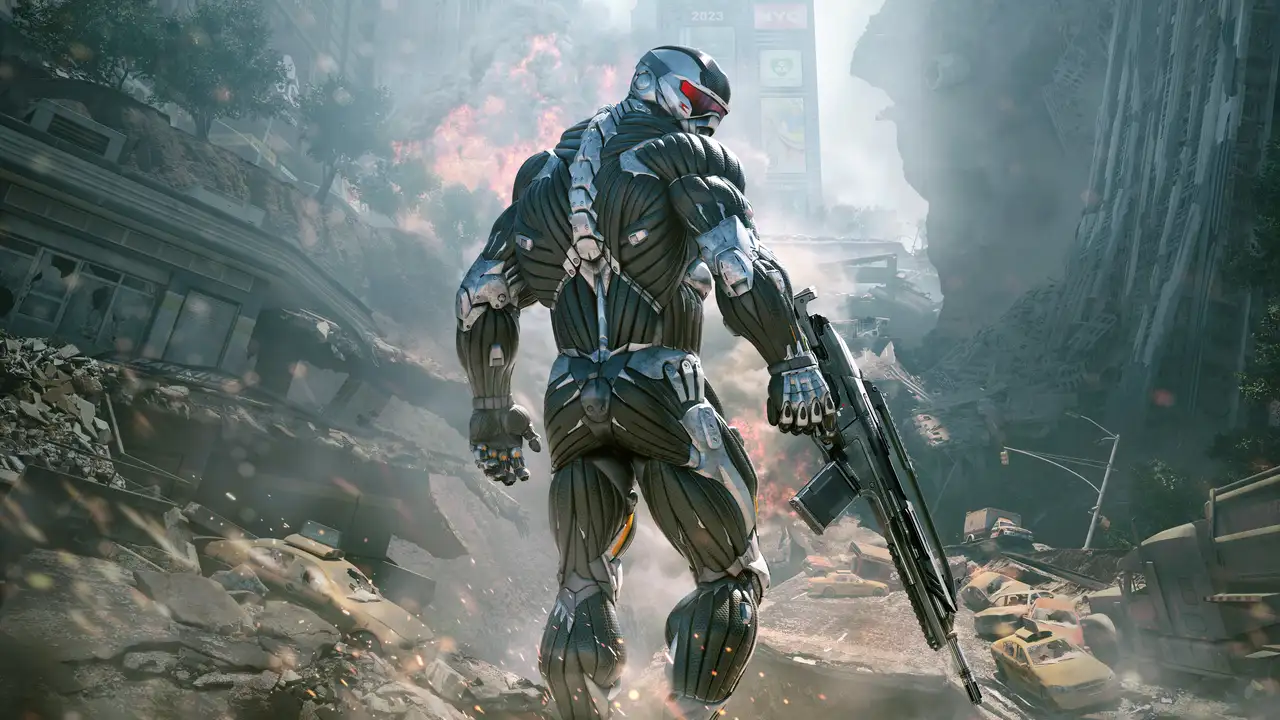
Set-piece direction defines the identity. Buildings collapse mid-firefight, ships capsize while the squad fights across their decks, and every level ships with at least one guaranteed destruction sequence, to the point of complete predictability. The formula invites parody without diminishing the spectacle, because the destructibility is real: environments take far more damage than the previous entry allowed, cover dissolves under sustained fire, and the set pieces are playable rather than watched. Few military shooters of the era commit this hard to continuous collapse as a core mechanic rather than a curtain.
Engage orders are the small system that quietly runs the squad combat. Companions idle until told to engage, which turns every firefight into a two-step ritual of command before the shooting starts, and the companions themselves contribute little beyond covering fire once commanded. The gunplay itself is smooth by console standards, burst-fire settings stretch scarce ammo, and gadget stashes reward map awareness. Vehicle segments (boats, tanks, attack helicopters) run on unconventional left-stick-throttle controls that work surprisingly well, though the tank gauntlet in Singapore still produces the campaign’s worst death count.
The Singapore tank chapter is also where enemy health becomes unbearable. Opponents absorb astonishing volumes of fire while the same ammunition fells the player in a fraction of the rounds, inverting the power fantasy in the wrong direction, and the anti-tank-mine placement near the bridge carries a proximity radius so generous it becomes a trap for its own deployer. A stalled objective trigger in the Shanghai tower chapter compounds the sense of a campaign fighting its own scripting, and dog tags and collectibles offer little reason to deviate from the critical path.
Presentation is where the campaign does its real damage. Lens flares assault nearly every frame, bright enough to obscure combat and with no toggle anywhere in the settings, and the complaint outlasts every other grievance. Pop-in and clipping recur throughout, objects flickering in and out of existence mid-firefight, and the hub menu confuses more than it guides. An in-game advertisement for a later series entry, wedged into an older product, lands as exactly the kind of cross-promotion nobody asked to find inside a campaign.
The AI companions deserve their own mention for sheer passivity, idling through firefights until engaged and contributing nothing tactical beyond a distractible hail of covering fire. The squad drama they anchor, however, works: leadership friction within the unit, loyalty questions around one member, and a finale whose sacrifice carries the weight the script has been building toward across all seven missions. The Dima cameo rewards series continuity watchers without demanding prior knowledge, and the tone stays self-aware throughout, never mistaking its B-movie register for gravity.
Overall, this is a fun, spectacle-heavy campaign whose flaws are almost entirely cosmetic rather than structural: the collapsing sets, the smooth gunplay and the affecting squad finale carry it comfortably past the lens flares, the sponge enemies and the jank. Every complaint is specific and fixable, and none of them touches the momentum that makes the seven missions fly. Judge it on the spectacle and it delivers exactly what the formula promises.