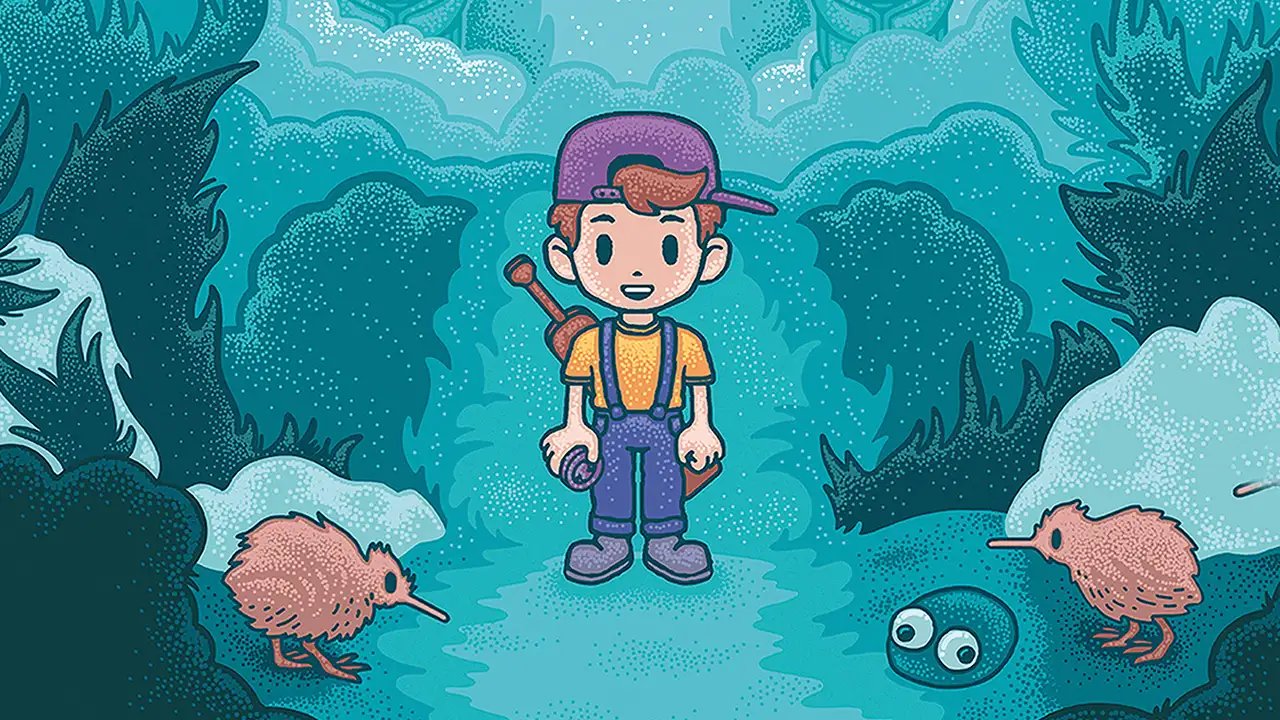
Ta Romi Island carries a Maori-flavoured legend of four brothers betrayed at sea, their wrathful spirits now haunting the shores. Reverie builds its whole identity on that setting: an Aotearoa island rendered with real cultural detail, from the koru pendant to a korowai cloak reward, wrapped in a relaxed holiday framing where the threats never quite darken the mood. The opening myth is told with genuine care, and the tone stays gentle throughout, closer to a beach holiday with haunted corners than a perilous quest.
The homage to A Link to the Past is worn openly and works because the design earns the comparison. Six dungeons gate progression behind quest items (a lantern, a dart gun, a yo-yo, Steve-the-rock, a snorkel and a hook), and the lineage maps precisely: darts act as the bow, the yo-yo as the boomerang, wheel shoes as Pegasus boots. Familiar puzzle grammar rewards recognition, and the compact island’s interconnected layout means that knowledge carries forward. The top-down structure is faithful without being a transplant.
The feather-collectible system is the island’s structural spine and its best idea. A journal of real New Zealand birds doubles as an achievement tracker, its entries doubling as genuine conservation-flavoured facts about extinct species and endangered parrots, and the stamps on its notebook pages literally represent unlocked achievements. Collectibles, achievements and lore braided into one loop gives a compact island genuine completionist pull, and a post-credits continue mode sensibly lets stragglers be picked up after the credits.
Difficulty balance is the sharpest friction. Two-hit deaths on a small health pool paired with relentless contact damage make brushes with enemies disproportionately punishing, softened only late by an invincibility cloak that trivialises the challenge dungeon when equipped. An inventory limited to two equipped items forces awkward swapping, and the feather journal can only be opened by physically returning to the bedroom rather than being checked from anywhere. Each is a small constraint; together they make a relaxed adventure feel needlessly rigid in spots.
The Crypt dungeon is the low point. Rooms of nothing, key-hunting sprawl with no map feedback about which rooms have been cleared, and a hidden one-way exit that never shows on the map turn a short dungeon into a frustrating memory exercise. The later Lagoon dungeon compounds it with another hidden one-way exit and a challenge room that leans on the invincibility cloak, and the ending arrives so abruptly that the Lagoon’s actual purpose never resolves into anything legible. Level design elsewhere is tidy, so the Crypt’s opacity reads as an exception rather than a pattern.
The story stays cosy throughout: knick-knack humour involving a possessed tumble dryer, kiwis scheming to become chefs and a fugitive uncle, plus beach-town side characters with dry lines. A legend of Heke and his three brothers provides the mythic frame, and the spirits haunting the island give the dungeons a narrative spine without ever demanding much. The ending’s abruptness undercuts the atmosphere, closing on confusion where a gentle denouement would have fit the tone.
The whole island can be cleared in a brisk few hours, and every feather and achievement stamp is attainable without dedicated grinding, which suits the loop the journal builds. Steve, a rock with googly eyes carried through the Crypt, becomes an unexpected highlight of an inventory otherwise constrained by its two-slot limit. The charm here is specific: endemic bird facts, Maori design touches and Zelda grammar in a new setting.
Overall, this is a devoted, affectionate homage to A Link to the Past set on a lovingly realised New Zealand island, and its feather journal turns a short campaign into a complete collectible ecosystem that rewards seeing it through to the final stamp. Contact damage tuning, the Crypt’s opaque key-hunting and an abrupt ending are real blemishes, but the charm, the cultural detail and the completionist loop carry the island tour with room to spare.