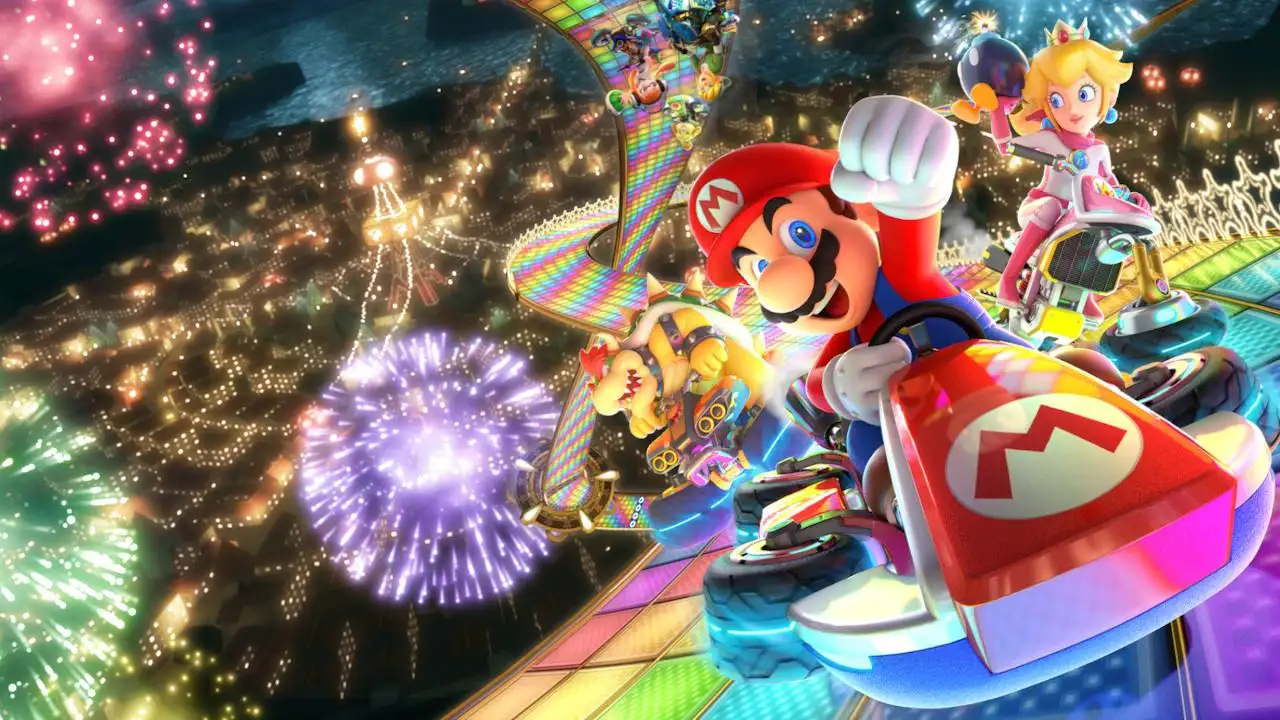
The only arcade Mario Kart, running Namco’s crossover roster of Pac-Man, Ms. Pac-Man, Blinky and Don-chan alongside the usual racing cast, on 2003 Triforce hardware that still looks remarkably good. The appeal is novelty and atmosphere, a cabinet-era curio whose creative ideas never left the arcade. Dozens of unique items fill the pool, including a Thunder Stick that is nothing more than a hilarious bonk stick. The item variety alone distinguishes it from every home entry of the era. As a crossover experiment, nothing else in the series matches it.
Emulation carries the experience well, though it flattens the cabinet theatre the game was built for. The Triforce board renders cleanly at modern resolutions, the frame rate never stutters, and the racing itself translates perfectly to a standard controller. What is lost is the periphery: the rumble seat, the force-feedback wheel, the photo-printing gimmick and the sheer presence of sitting at a machine that charges by the race. Simulated credit costs become period comedy rather than real expense, and the arcade card system’s stubborn defaulting to an old save becomes a hurdle the original hardware handled invisibly. The game survives the translation; only its context does not.
The challenge games between races are bizarre but fun micro-challenges gating each cup, and the Pac-Man Cup’s labyrinth track transforms the kart race into an actual Pac-Man maze, the single most creative moment in the game. The Rainbow Cup rotates gimmick races (no items, dash-mushrooms-only, thunder-stick-only, free-for-all), and a Robo Mario chase closes the Special Cup. Track reuse is the main structural criticism: most cups recycle one layout across variants, with first and third stages literally identical and second and fourth swapped. Under-twenty-second ovals in the early cups compound the sameness. The creativity peaks exactly where the reuse does not.
The coin economy punishes collisions while AI rivals carry no coins to lose and receive items unavailable to the player, and simulated per-track credit costs make the whole exercise a running monetisation joke. Jump drift discovered late transforms the handling for the better, with sideways landings triggering boosts, and the absent rear-throw remains a strange omission for a kart racer. Items largely underwhelm in effect despite their variety. The arcade card system defaulting to an old save is the first hurdle of the session. Mechanics land somewhere between inventive and half-finished.
Progression flows through the arcade card system, whose saved profile defaulted stubbornly to an old record before being wiped entirely, and each cup’s entry cost becomes part of the period comedy.. The cabinet’s rumble seat, photo-printing gimmicks and force-feedback wheel sell the arcade fantasy that emulation can only approximate. Playing it through emulated Triforce hardware flattens some of that theatre, though the racing itself translates perfectly. The home-console version that never happened would have solved every friction point here in one stroke. Instead the game remains a locked-room experiment, brilliant and inaccessible in equal measure.
The Bowser Cup’s jump challenge game makes no sense and costs extra credits to clear, the only outright failure among the micro-challenges. The Mario Cup’s basic ovals bore before the later cups earn their keep, and the Special Cup unlock gives the completion loop a real destination. A single session clears every cup, which speaks to the brief, punchy race loop the arcade format demands. The visual fidelity for the hardware era is genuinely impressive. Everything here is short, dense and gone too soon.
Overall, the huge item roster, the bizarre challenge games and the Pac-Man Cup’s labyrinth transformation make this a brief but creatively rich arcade curio that deserved the home-console release it never received. Recycled track variants, coin-punishing collisions and one incomprehensible challenge game hold it back, and the tracks were never adapted into later entries. It should have been the series’ world tour, and the fun survives the arcade trappings completely.