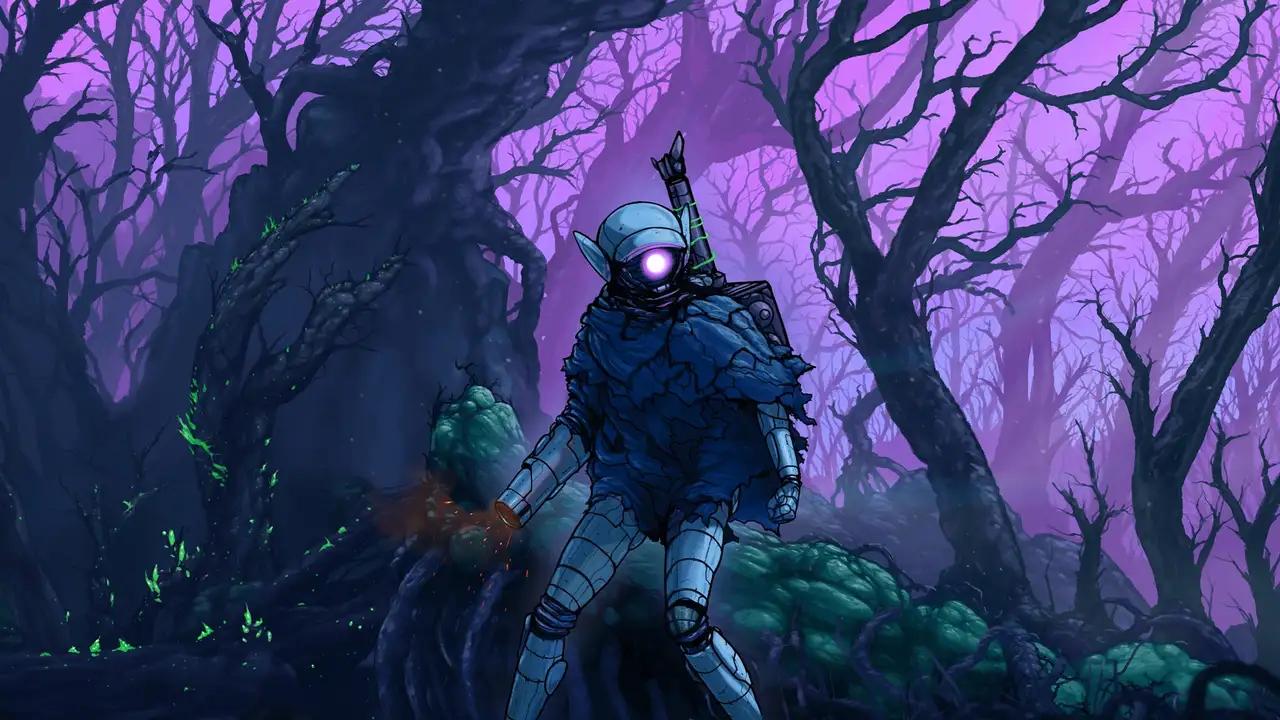
A crashed freighter sits rotting on the surface of a dead moon, its small crew waiting on repairs that never seem to arrive. Ghost Song builds its melancholy sci-fi from that image: a worm god gnawing the sun, ghosts drifting through water, an armoured courier retrieving the parts that might get everyone home. Structurally this is a Metroidvania in the familiar mould, gated by colour-coded ship parts and steadied by ability unlocks that reopen old ground. Yet the texture is unlike anything else in the genre, because the writing refuses to behave like background furniture. Every member of the consensus-run crew, from a poet-chef to a body-building android, carries a monologue worth hearing.
Camp dialogue drives the whole enterprise. Voice acting stays minimal, a line here and there over text, but the delivery adds weight rather than subtracting it. Raven speaks about leaving a body behind with a calm that lingers long after the conversation ends. Pasha mourns a sister; the Gambler spins poetry about a ship’s soul; Bill turns out to write verse while Roper once danced. Returning after each delivered part reshapes these vignettes, and the cadence of repair runs doubles as the cadence of getting to know people. Depth like this costs nothing mechanically and earns everything tonally.
Progression layers a Souls-like three-stat system (Gun Power, Vigor, Resolve) onto a Hollow Knight-style currency loop, with repair costs scaling alongside suit damage. The heat-based blaster anchors combat: spam overheats the weapon and bleeds damage, a trade-off that penalises excess without punishing it outright. Sub-weapons stack on top, and the poison shells in particular shred through armour. Missiles add burst, and each unlock visibly rewrites how the world plays. The three-stat spread lets builds lean into guns, grit or endurance in ways the usual single-upgrade-path design never permits.
Boost boots transform traversal. Before them, movement fights the player with floaty momentum and platforms thin as wire, and an early wrong turn deep into the yellow region makes the friction feel deliberate. Wall jump and double jump arrive soon after and start smoothing the rough edges, but boost boots fix the problem outright; sections that once demanded careful commitment become fluid. What reads as poor design in the opening hours reveals itself as a progression curve that front-loads its worst terrain, and by the finale the early clumsiness feels like a distant complaint.
Bosses and set-pieces vary wildly in quality. The recurring Old Singer stalks through arenas so cluttered that its clever design drowns in the scenery, and one fight in the yellow region gets dropped into a room too small for it. Stealth-drain ghost enemies drift through the world, remaining unexplained from first encounter to credits, their rules never stated. Neither problem sinks the campaign, but both read as oversights rather than choices. Encounters feel best in open ground where the blaster’s heat economy and poison stacking can breathe.
Economy tuning wobbles late. The final shop module demands over 5,000 nano gel while ordinary enemies drop trivial sums, turning the last stretch into a grind. Worse is the ship-part death rule: dying while carrying a part warps the courier back to it with zero heals and barely any health, an unexplained punishment. Fast travel disables itself whenever a part is carried, with no in-lore justification offered. Occasional visual glitches and broken animations punctuate the polish. Repair costs ranging from 16 to 2,400 nano gel force periodic camp returns, which at least feeds the dialogue cadence.
The identity here belongs entirely to the writing. Nine years in development by a tiny team, the game spends its budget on voices rather than scale: a consensus-anarchist crew, ghosts with literary monologues, a cosmology of a worm devouring light, and a protagonist who chats gently with broken robots. Sombre and chill in equal measure, the atmosphere seeps through every frame without a cheap scare. Environmental storytelling through dated logs and mute ruins fills in the dead moon’s history, while the living cast carries the emotional present.
Overall, this is a melancholy, beautifully written exploration game whose rough early traversal is fully redeemed by mobility unlocks and one of the genre’s more human stories. The camp vignettes alone justify the journey, and the heat-based combat earns its place beside them.