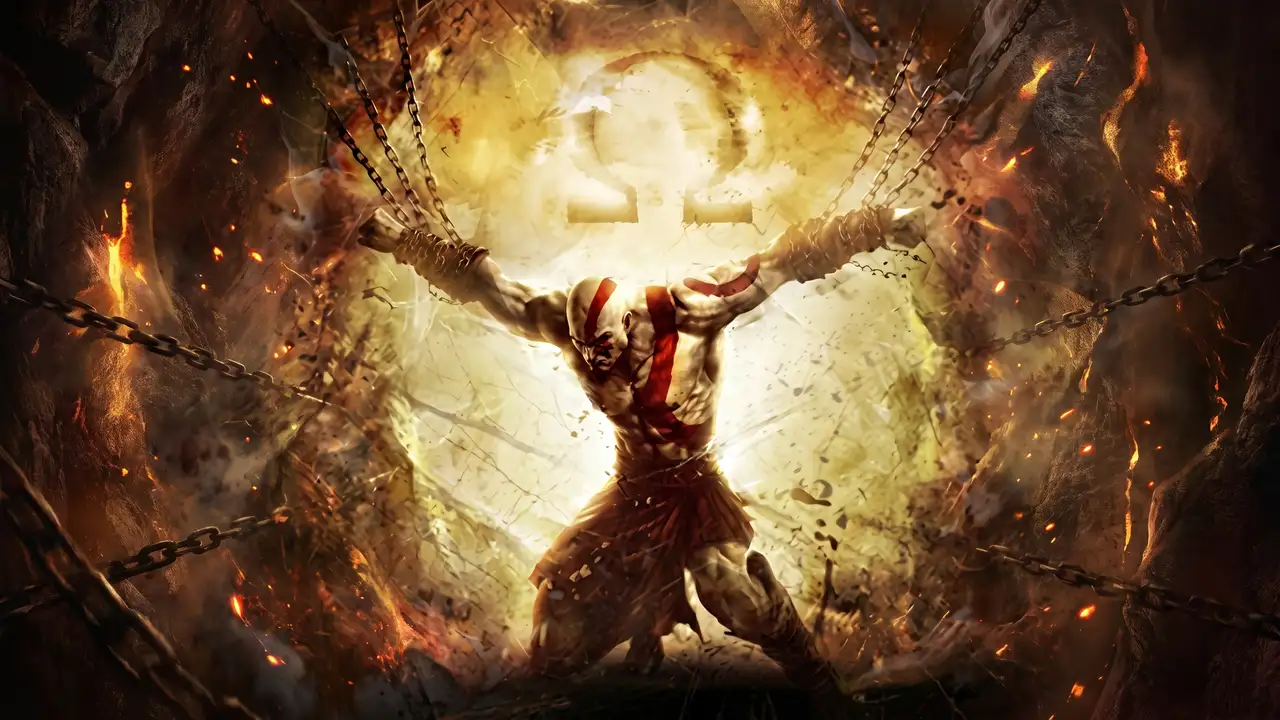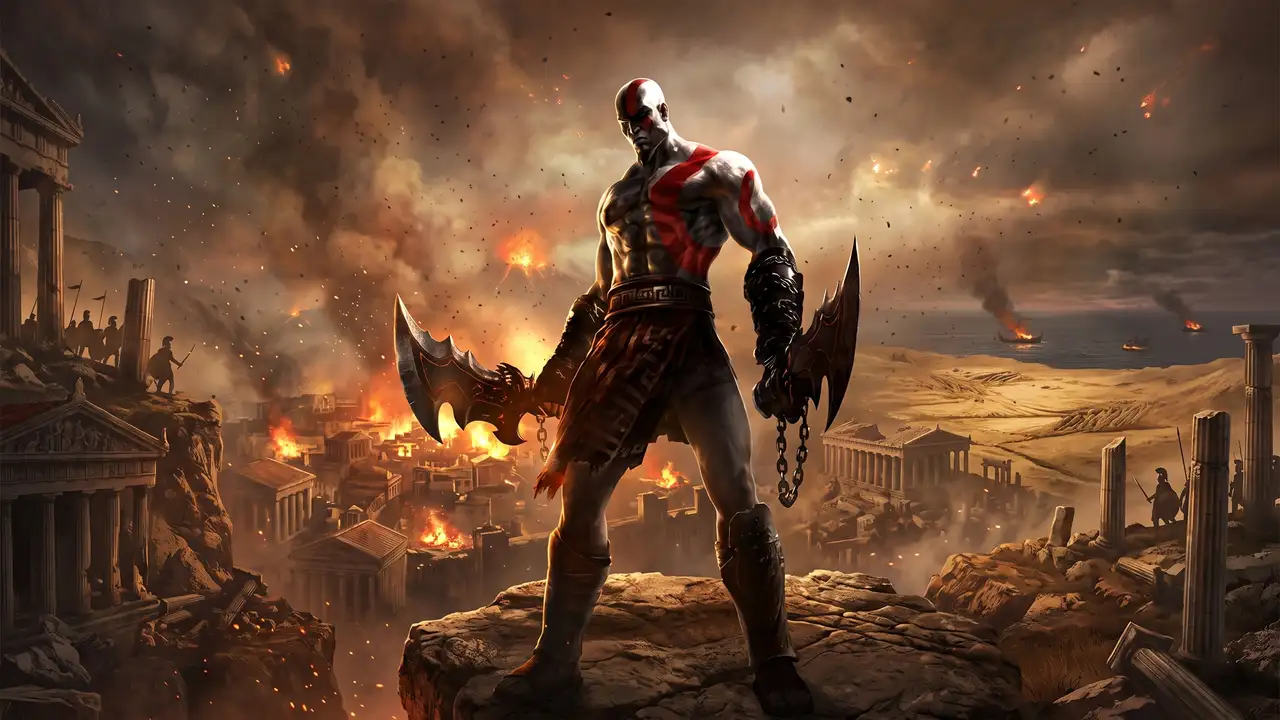
A Spartan warrior drained of his power by divine deception sets out on a march toward the weavers of destiny themselves, and the sequel built around that premise improves nearly everything its predecessor established. The betrayal setup gives the campaign clear momentum, the Titan mythology reframe broadens the world beyond Olympus, and foreshadowing is planted early enough to reward attention. Story delivery leans heavily on cutscenes for its era, but the writing holds the weight, and the journey’s connective tissue lands with more coherence than most action games manage. Time manipulation doubles as both a puzzle verb and a plot device, tying theme and mechanics together.
Combat is where the refinements concentrate. The control scheme changes and expanded move-set make execution feel faster and more fluid, and traversal along ropes and walls speeds up noticeably, removing the dead stretches that slowed the original. Balance beams are wider, the camera behaves during tiptoe sections, and upgrades arrive at a brisk pace, with orbs displayed as a raw count rather than obscure levels. Progression that once took eons now flows steadily, and the constant drip of new capabilities keeps encounters evolving.
The new tools each reshape traversal or combat in distinct ways. Typhon’s Bane offers ranged options, Icarus Wings unlock gliding, Atlas Quake delivers area damage, and the Golden Fleece rewards well-timed deflection once its window is understood. The Amulet of the Fates ties time-slowing to environmental puzzles, and its integration with level design is genuinely clever. Together the arsenal gives the mid-game its variety, and each acquisition changes how existing encounters can be approached.
The Barbarian’s Hammer is the arsenal’s misfire. Its slowness grates against the otherwise fluid combat, and the weapon never sheds the feeling of an obligation rather than an option. The magic line-up fares worse still, lacking the invincible area-of-effect spell that made the first game’s magic worth casting, and the roster reads as a step backwards. Combined with enemies whose entire strategy is constant blocking, the combat’s weakest moments cluster around what to use rather than how well the core mechanics perform.
Boss design splits unevenly. Mid-game encounters with Theseus, Perseus and the Barbarian King are serviceable to the point of anonymity, memorable mostly for spectacle rather than mechanics. The late-game pivot jars hardest: the Sisters of Fate fight and the closing Cloth sequence transform combat encounters into environmental puzzles, a design shift that drags the finale well past its natural length and turns the last hours into a grind. The final confrontation overstays, and the pacing from roughly the midpoint onward tilts from exhilaration to obligation.
Visual presentation carries its own complications. The game is handsome for its platform, and the PS3 HD treatment flatters it further, but community texture packs are a trap: see-through and invisible textures obscure gameplay elements and demand repeated hotkey fixes. The atmosphere, meanwhile, is noticeably less grand than the first game’s journey, trading vast scale for tighter, more intimate staging. Neither point undermines the craft, but both colour the experience. The ending itself, staging the Titans’ ascent of Olympus, functions as a direct cold open for the next chapter and lands as a genuine thrill.
Overall, this is an upgrade in nearly every measurable way over its predecessor, carried by refined combat, faster traversal and story momentum that holds to the final frame. The late-game puzzle bosses, the weaker magic line-up and the anonymous mid-game encounters blunt the closing stretch, and the scale feels smaller than before. The core spectacle and mechanical polish still make it the stronger game.